Mileage Tracking for Rental Property: How Landlords Can Maximize Tax Deductions
Every trip to a rental unit, whether you’re fixing a leaky faucet, meeting a prospective tenant, or picking up supplies from the hardware store, puts miles on your odometer and money back in your pocket at tax time. Yet a surprising number of landlords either ignore mileage deductions entirely or track them so poorly that […]
Every trip to a rental unit, whether you’re fixing a leaky faucet, meeting a prospective tenant, or picking up supplies from the hardware store, puts miles on your odometer and money back in your pocket at tax time. Yet a surprising number of landlords either ignore mileage deductions entirely or track them so poorly that the deductions would crumble under the lightest IRS scrutiny. At the 2026 federal standard rate of 72.5 cents per mile, a landlord who drives just 5,000 qualifying miles in a year is looking at a $3,625 deduction. These are real dollars that reduce taxable rental income reported on Schedule E. Scale that across multiple properties or an out-of-state portfolio, and the figure climbs fast. The catch is that the IRS demands meticulous documentation, and “I drove a lot for my rentals” will not stand up to an audit. This guide breaks down exactly which trips qualify and how modern tools make the entire process nearly effortless.

Which Trips Actually Qualify as Rental Property Mileage
Not every drive related to your rental business is deductible, and misunderstanding the rules is one of the fastest ways to trigger an audit. The IRS allows mileage deductions for travel that is both “ordinary and necessary” for managing or maintaining a rental property. Qualifying trips fall into several categories:
- Property Maintenance & Repair Visits: Trips taken to oversee or perform maintenance and repairs at a rental property generally qualify for mileage deductions. This includes driving to inspect damage, supervise contractors, address tenant repair requests, and perform routine maintenance tasks such as replacing fixtures and checking appliances. The key requirement is that the trip directly supports the upkeep or functionality of the rental property. Landlords who actively manage their units often make multiple visits throughout the year, and documenting these trips carefully can add up to a meaningful deduction when filing taxes.
- Tenant Showings & Leasing Activities: Driving to a property to show it to prospective tenants is another common qualifying mileage category. Landlords frequently travel to meet applicants, conduct walkthroughs, or provide access for potential renters. Trips related to lease-signing meetings, move-in, and move-out inspections are deductible because they are directly tied to managing occupancy.
- Trips for Rental Business Financial Tasks: Mileage incurred while completing financial tasks tied to rental management is typically deductible. For example, driving to a bank to deposit rent payments, pick up cashier’s checks, or handle account matters related to rental income qualifies as ordinary business travel. Similarly, trips to meet accountants or tax professionals to discuss rental income, expenses, or compliance issues are deductible as mileage. Because these tasks directly relate to managing the financial side of the rental operation, they are generally accepted as necessary travel under IRS guidelines.
- Purchasing Supplies & Property Materials: Landlords often drive to hardware stores, appliance retailers, or building supply centers to purchase materials needed for rental properties. Mileage for these trips usually qualifies when the purchases directly support property maintenance, upgrades, or tenant needs. Items such as paint, cleaning supplies, tools, replacement appliances, and fixtures all fall under normal operating expenses. As long as the travel’s purpose is to obtain materials for managing or maintaining the rental property, it is typically treated as deductible mileage when properly documented.
- Professional Meetings & Property Management Services: Travel to meet professionals who assist with rental property management is generally deductible as well. This can include meetings with contractors or real estate professionals discussing property operations. Landlords may also drive to meet service providers involved in maintaining or evaluating a rental property.
Understanding which trips qualify helps landlords maintain accurate mileage logs and avoid mistakes that could trigger scrutiny during a tax review. By focusing only on travel that directly supports rental operations, landlords can confidently claim deductions that comply with IRS guidelines while keeping clear records that support their filings.
Standard Mileage Rate vs. Actual Expenses: Choosing the Right Method
The Standard Mileage Method
The IRS mileage rate for 2026 is 72.5 cents per business mile, up from 70 cents in 2025. You simply multiply your total qualifying miles by the rate. If you drove 4,000 miles for rental activities, your deduction is $2,900. You track miles and multiply, and there are no receipts required for gas, oil changes, or tire rotations. One detail many landlords overlook is that 30 cents of the standard rate represents a built-in depreciation component. That means the IRS treats you as depreciating your vehicle each year you use the standard rate, which reduces the vehicle’s cost basis and could create a taxable gain if you eventually sell the car for more than its adjusted basis.
The Actual Expense Method
Under this approach, you tally every vehicle-related cost and multiply the total by the percentage of miles driven for the rental business. If your total vehicle expenses for the year were $9,000 and 30% of your driving was rental-related, you would deduct $2,700. The actual expense method can yield a larger deduction when you drive a newer or more expensive vehicle with high fixed costs relative to your mileage. However, it demands significantly more record-keeping, and once you choose actual expenses in the first year you use a vehicle for rental activities, you generally cannot switch to the standard mileage rate for that vehicle in later years. The reverse is more flexible. You can switch from the standard rate to actual expenses.
What the IRS Expects: Record-Keeping That Survives an Audit
IRC Section 6001 requires taxpayers to maintain records that substantiate every deduction, and courts have consistently held that deductions are a matter of legislation, not entitlement. In the 2018 Khan v. Commissioner case, the Tax Court disallowed a landlord’s entire vehicle deduction because the mileage log lacked corroborating evidence.
To track mileage for taxes effectively, every log entry needs four elements:
- the date of the trip
- the starting and ending locations
- the purpose of the trip (e.g., “property inspection at 412 Oak St” or “met contractor for HVAC bid”)
- the odometer reading or total miles driven.
The IRS expects contemporaneous records, meaning you should log each trip at or near the time it happens. Beyond the log itself, IRS examiners are trained to look for corroborating evidence. Having at least some of these backup records can be the difference between a clean audit and a disallowed deduction. Claiming 100% business use of a vehicle is one of the most common audit red flags, especially if no second vehicle is available for personal use. Unless you genuinely have a dedicated rental-only vehicle, be honest about the personal-to-business split and document it carefully.
Landlord Expense Tracking Beyond Mileage: The Full Deduction Picture
Operating Expenses and Repairs
Routine rental property expenses are deductible in the year you pay them. The key distinction is between a “repair” (restoring something to working condition) and an “improvement” (adding value or extending useful life). Replacing a broken water heater is a repair and is immediately deductible. Renovating an entire kitchen is an improvement and must be capitalized and depreciated.
Depreciation and Cost Segregation Rental Property Strategies
Residential rental buildings are depreciated over 27.5 years under the IRS’s Modified Accelerated Cost Recovery System. But with the restoration of 100% bonus depreciation under the One Big Beautiful Bill Act signed in July 2025, landlords now have a powerful tool to accelerate write-offs on qualifying components.
A cost segregation rental property study is an engineering-based analysis that reclassifies portions of a building from 27.5-year property into 5-, 7-, or 15-year asset classes. Those reclassified components then qualify for bonus depreciation, allowing you to deduct them entirely in the first year. On a $500,000 residential property, standard straight-line depreciation yields roughly $17,425 in year one. A cost segregation study that reallocates 20% of the building’s basis to shorter-lived assets can push first-year depreciation above $113,000. The study itself typically costs $5,000 to $15,000, making the return on investment significant for properties valued above $200,000.
If you plan to claim depreciation on rental property assets aggressively, ensure you have enough passive income or meet the active participation threshold to absorb the deductions. Under the passive activity loss rules, landlords who actively participate in management can offset up to $25,000 of non-rental income with rental losses, subject to income phase-outs.
Rental Property Tax Tips for Maximizing Every Deduction
Keep Business and Personal Finances Separate
Open a dedicated bank account and credit card for your rental business. When every rental-related transaction flows through its own account, year-end accounting becomes a matter of exporting statements rather than sorting through hundreds of mixed transactions. This single habit simplifies expense management and gives you a clear paper trail if the IRS ever comes knocking.
Tax Deductions
Rental property tax deductions reduce your taxable income. A $3,000 mileage deduction in the 24% bracket saves you $720 in federal tax. Tax credits, by contrast, reduce your actual tax bill dollar for dollar. While most landlord benefits fall on the deduction side, certain energy-efficient improvements may earn credits under the Inflation Reduction Act. Know the difference so you capture both.
A tax deduction tracker app removes the manual burden of logging expenses and eliminates the risk of forgotten deductions. The best tools auto-categorize transactions, sync with bank accounts, and generate Schedule E–ready reports. For mileage, GPS-enabled apps log trips in the background, so you never have to scribble in a notebook after a property visit. The result is cleaner records, higher deduction capture, and less stress at tax time.

Some real estate tax deductions are widely claimed, such as mortgage interest, property taxes, and insurance. Others are consistently missed. These include the cost of professional development, home office expenses if you manage rentals from a dedicated space, and even certain closing costs on property acquisitions. Section 179 expensing limits were also raised to $2.5 million under the 2025 tax law, giving landlords more room to fully expense qualifying improvements like roofs, HVAC systems, and security installations in the year of purchase.
Finding the Best Mileage Tracker for Landlords
The market is crowded with mileage apps, but not all are built for the way landlords actually work. The best mileage tracker for landlords ties trip data to specific properties, categorizes trip purposes in rental-relevant terms, and exports reports that align with Schedule E categories. When evaluating options, prioritize automatic trip detection, the ability to tag trips by property address, IRS-compliant reporting formats, and integration with your broader accounting system. A tracker that lives inside your existing property management system eliminates the need to reconcile data across separate platforms.
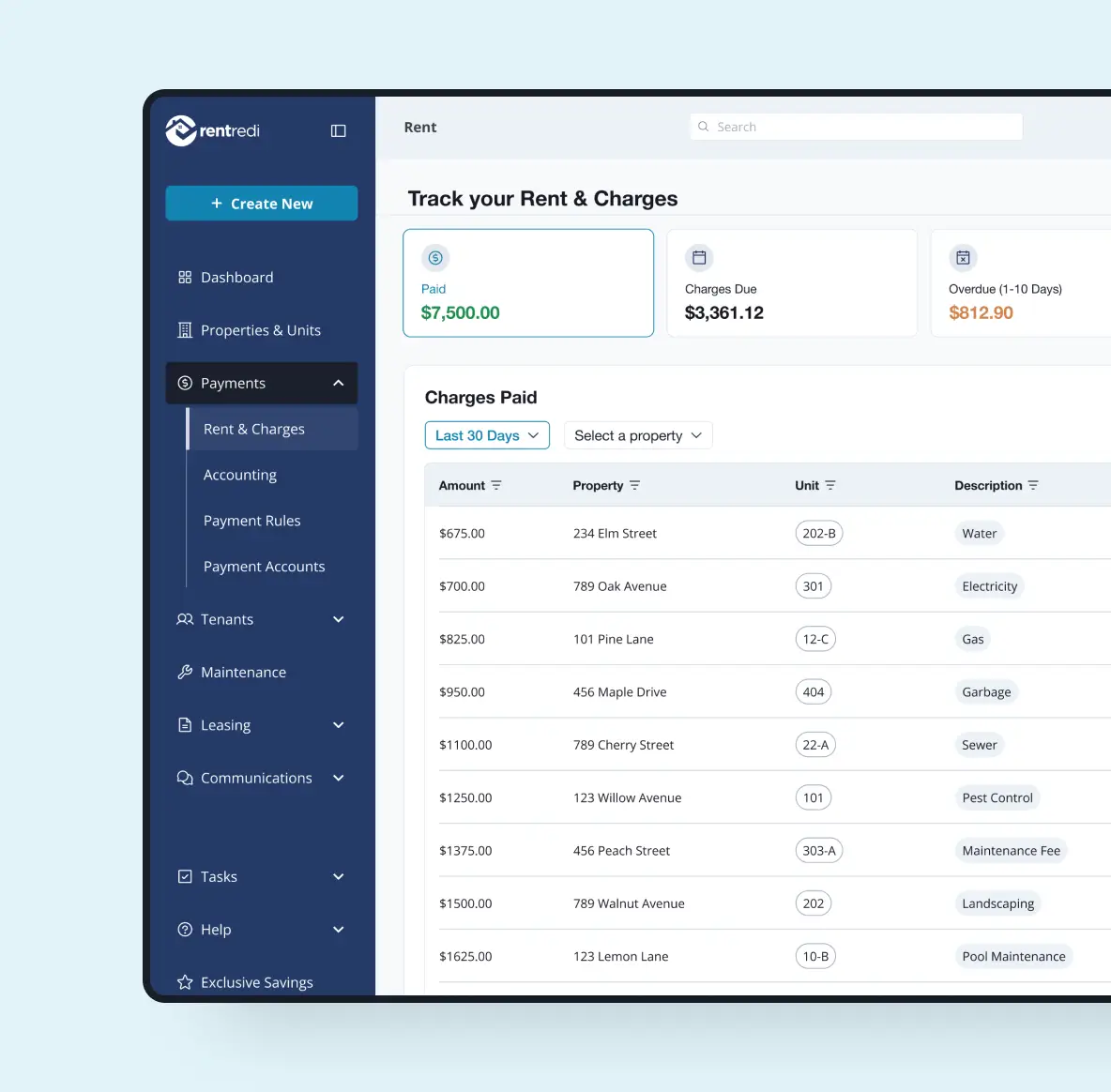
For landlords managing multiple units, a platform like RentRedi brings mileage tracking, rent collection, maintenance coordination, tenant screening, and accounting into a single dashboard. RentRedi was named to the 2026 HousingWire Tech100 Real Estate list for the second consecutive year, and has been recognized by both Capterra and Software Advice as a top-tier solution. Having your trip logs alongside lease details, repair histories, and financial reports means everything an auditor might ask for lives in one place.
Choosing the Best Property Management Software for Tax Season and Beyond
What to Look For in a Professional Property Management Software
The best property management app should offer automated rent collection with late-fee enforcement, tenant screening and online applications, maintenance request tracking with photo and video documentation, and robust financial reporting that maps to IRS categories. Professional property management software goes a step further with features like customizable listing syndication to major rental sites, team member access for property managers and co-investors, and API integrations with accounting platforms. A strong platform also scales with your portfolio. Whether you own two doors or two hundred, the platform should handle unlimited units without per-unit pricing surprises.
When your mileage tracker, expense tracker, and property management platform share data, you eliminate duplicate entry and reduce the risk of missed deductions. You also create a unified audit trail. If the IRS questions a mileage deduction, you can pull up the corresponding maintenance request, the vendor invoice, and the bank transaction, all linked to the same property and the same date. That level of documentation is what turns a hopeful line item into an ironclad deduction.

How to Stay Consistent With Your Mileage Log
Consistency is the hardest part of mileage tracking. Most landlords start the year with good intentions, fall off by March, and end up estimating in April. That pattern is exactly what invites IRS scrutiny. Build the habit by anchoring it to an existing routine. Every time you start your vehicle for a rental-related trip, open your tracking app and classify the trip before you shift into drive.
The landlords who capture every deduction are not necessarily doing more work but are using better systems. A reliable mileage tracker feeds into a comprehensive expense management workflow, which in turn feeds into clean Schedule E reporting, which yields the maximum legal deduction. Start with the basics: choose the standard mileage rate or actual expenses, log every qualifying trip with the four data points the IRS requires, and use a dedicated mileage tracker that integrates with your broader rental property expenses management tools. Layer in strategies such as cost segregation studies and bonus depreciation when the numbers justify the investment. And keep every record for at least seven years. The difference between a landlord who deducts $500 for travel and one who correctly deducts $5,000 often comes down to discipline and the right software. The miles are there, the deductions are there, and you just have to track them.
Sources:
- IRS Publication 527 — Residential Rental Property
- IRS Publication 463 — Travel, Gift, and Car Expenses
- IRS Standard Mileage Rates
- IRS Topic No. 414 — Rental Income and Expenses
- IRS Tips on Rental Real Estate Income, Deductions, and Recordkeeping
- HCVT — Viability of Cost Segregation Studies for Tax Year 2025
- MGO CPA — Why Cost Segregation Just Became More Valuable
- GlobeNewsWire — RentRedi Voted Top-Tier by Landlords (2026)
- Kiplinger — What Are Your Chances of an IRS Audit?
- WCG CPAs — Mileage Myths Busted: Khan v. Commissioner