Landlord Mileage Tracking: A Simple Guide to IRS-Compliant Records

Every trip to a rental property is a potential tax deduction. The miles driven to meet a contractor and the visit to show a vacant unit to a prospective tenant can reduce your taxable income. Yet a surprising number of landlords either skip the deduction entirely or track it so loosely that the IRS would […]

9 min read

Every trip to a rental property is a potential tax deduction. The miles driven to meet a contractor and the visit to show a vacant unit to a prospective tenant can reduce your taxable income. Yet a surprising number of landlords either skip the deduction entirely or track it so loosely that the IRS would toss it out in seconds. The cost of getting this wrong is real. This guide walks through exactly what counts as deductible mileage, how the IRS expects you to document it, which tracking method saves you more money, and how to build a system that holds up if you’re ever audited. Getting landlord mileage tracking right is one of the simplest ways to protect your bottom line.

What the IRS Actually Considers Deductible Mileage for Landlords

The IRS draws a clear line between deductible business travel and nondeductible commuting, and landlords frequently land on the wrong side of it. If the trip is directly related to operating your rental business, the miles qualify. The trip that does not qualify, and the one that trips up the most landlords, is the commute. If you drive from your home to your rental property and your home is not your principal place of business, the IRS treats that as a personal commute. However, if you have a dedicated home office that qualifies under IRS rules, the drive from that home office to your property becomes a business trip. This distinction is worth understanding early because it can unlock or eliminate a significant chunk of your annual mileage deduction.

Landlord bookkeeping software needs highlighted as a property manager talks on the phone beside miniature house models and a calculator on her desk

Out-of-state travel adds another layer. If your rental property is in a different state, airfare, lodging, and 50 percent of meals during property management trips may also be deductible, provided the primary purpose of the trip is business-related. Combine business with a vacation, though, and you can only deduct the portion directly tied to rental activities.

The easiest way to think about it: if the trip would not exist without your rental property, the mileage is likely deductible. A drive to inspect a unit before a new tenant moves in? Deductible. A detour to your rental on the way home from dinner? Only the miles from your dinner location to the property, and then from the property to home, are deductible. Understanding exactly how landlords track mileage for taxes starts with knowing which miles count. Get that foundation right, and the rest becomes a matter of consistent documentation.

The 2025 and 2026 IRS Standard Mileage Rates

The IRS updates the standard mileage rate every year based on a study of the fixed and variable costs of operating a vehicle. For the 2025 tax year, the rate is 70 cents per mile. For 2026, it rises to 72.5 cents per mile, a 2.5-cent increase that reflects ongoing inflation in fuel and vehicle maintenance costs.

These rates apply to cars, vans, pickups, and panel trucks, including electric and hybrid vehicles. The rate is not just for gas. It bakes in depreciation, insurance, repairs, and maintenance. 30 cents of the 2025 rate represents the depreciation component alone. That matters if you later sell the vehicle, because you may need to account for depreciation recapture. For most landlords managing a handful of properties, the standard mileage rate is the simpler and often more advantageous option. If you drive 4,000 business miles in 2025, you would deduct $2,800 (4,000 × $0.70). For 2026, those same 4,000 miles would produce a $2,900 deduction. In addition to the per-mile rate, you can also deduct parking fees and tolls paid during qualifying business trips, as these are added on top of the standard mileage calculation.

Standard Mileage Rate vs. Actual Expense Method: Which Saves You More

The Standard Mileage Rate Method

This is the approach most landlords use. You multiply your total business miles by the IRS rate (70 cents for 2025, 72.5 cents for 2026), and that is your deduction. The recordkeeping is simpler, and you avoid the complexity of tracking individual expenses.

The Actual Expense Method

With this method, you track every dollar spent on the vehicle, such as gas, oil changes, tires, insurance premiums, repairs, registration fees, lease payments, or loan interest, and depreciation. At year’s end, you calculate the percentage of total miles that were business-related and apply that percentage to your total vehicle costs. If you drove 15,000 total miles in a year and 5,000 were for rental property management, your business-use percentage is 33.3 percent. If your total vehicle expenses were $9,000, your deduction would be $3,000.

This method can yield a larger deduction if your vehicle has high operating costs. Think of older vehicles that need frequent repairs or heavy trucks with expensive insurance. But the recordkeeping burden is significantly heavier, and if you sell the vehicle later, you face depreciation recapture taxes. Understanding both mileage deduction rules is essential before you commit to one path at the start of the tax year.

Building an IRS-Compliant Mileage Log That Survives an Audit

The Five Required Elements

Keeping a proper mileage log is essential for landlords who want to claim vehicle deductions confidently. The IRS requires detailed documentation for every business-related trip, and incomplete records can lead to deductions being denied. Every entry in your mileage log for landlords must capture five pieces of information:

  1. Trip Date Documentation: Every mileage entry must include the exact date the trip occurred. This helps establish when the business activity took place and ensures it falls within the correct tax year.
  2. Destination or Property Location: Each trip must identify where the travel occurred. This can include a specific rental property address, a hardware store, a bank, or a professional office visited for rental business. Listing a clear destination helps demonstrate that the travel was directly connected to managing or maintaining your rental property operations.
  3. Clear Business Purpose: The IRS expects a detailed explanation of why the trip occurred. Vague entries like rental property are not sufficient. Instead, specify the activity, such as meeting the contractor for roof repair, tenant showing, move-out inspection, or supply pickup. Specific descriptions strengthen documentation and reduce audit risk.
  4. Miles Driven for the Trip: Landlords must record the total number of miles driven for each qualifying trip. This figure determines the amount of mileage deduction claimed using the IRS standard mileage rate.
  5. Annual Odometer Readings: At the beginning and end of the tax year, landlords must record their vehicle’s odometer readings. These numbers establish total annual mileage and help confirm what portion of vehicle use was related to the rental business. This step helps validate the mileage log during tax preparation.

Maintaining a mileage log with these five elements ensures your records meet IRS documentation standards. Consistent entries not only protect your deductions but also provide a clear record of the business activities involved in managing and maintaining rental properties throughout the year.

The IRS considers a real estate mileage log to be “contemporaneous” if it is updated at least weekly. Logs that appear to be reconstructed at year’s end raise immediate red flags. The Tax Court in Khan v. Commissioner denied all vehicle deductions precisely because the records were not maintained on a regular basis. The best way to record rental mileage is at the time of the trip or within a day or two. This can be as simple as a note in your phone right after you park, or an automatic log from a GPS-based app.

The IRS requires you to retain your landlord tax records for at least three years after you file the return claiming the deduction. However, many tax professionals recommend keeping mileage logs for six to seven years, since the IRS can audit as far back as they suspect substantial underreporting.

Landlord mileage tracking and asset management illustrated by a man signing documents beside a miniature house and toy car on a desk

Choosing the Right Tool: Apps, Spreadsheets, and Software

Manual Spreadsheets

A spreadsheet with columns for date, destination, purpose, and miles driven is perfectly acceptable. It is free, customizable, and accessible to anyone comfortable with basic software. The downside is that it relies entirely on your discipline. Miss a week, and you are reconstructing from memory, which is exactly what the IRS looks for during an audit.

Dedicated Mileage Tracking Apps

A mileage tracking app that uses your phone’s GPS to automatically detect and record trips removes the biggest barrier to consistent tracking: human forgetfulness. Most apps let you classify trips with a swipe, add notes for business purposes, and export reports at tax time. For landlords making frequent property visits, automatic tracking saves significant time and produces the kind of detailed, timestamped records that hold up under scrutiny.

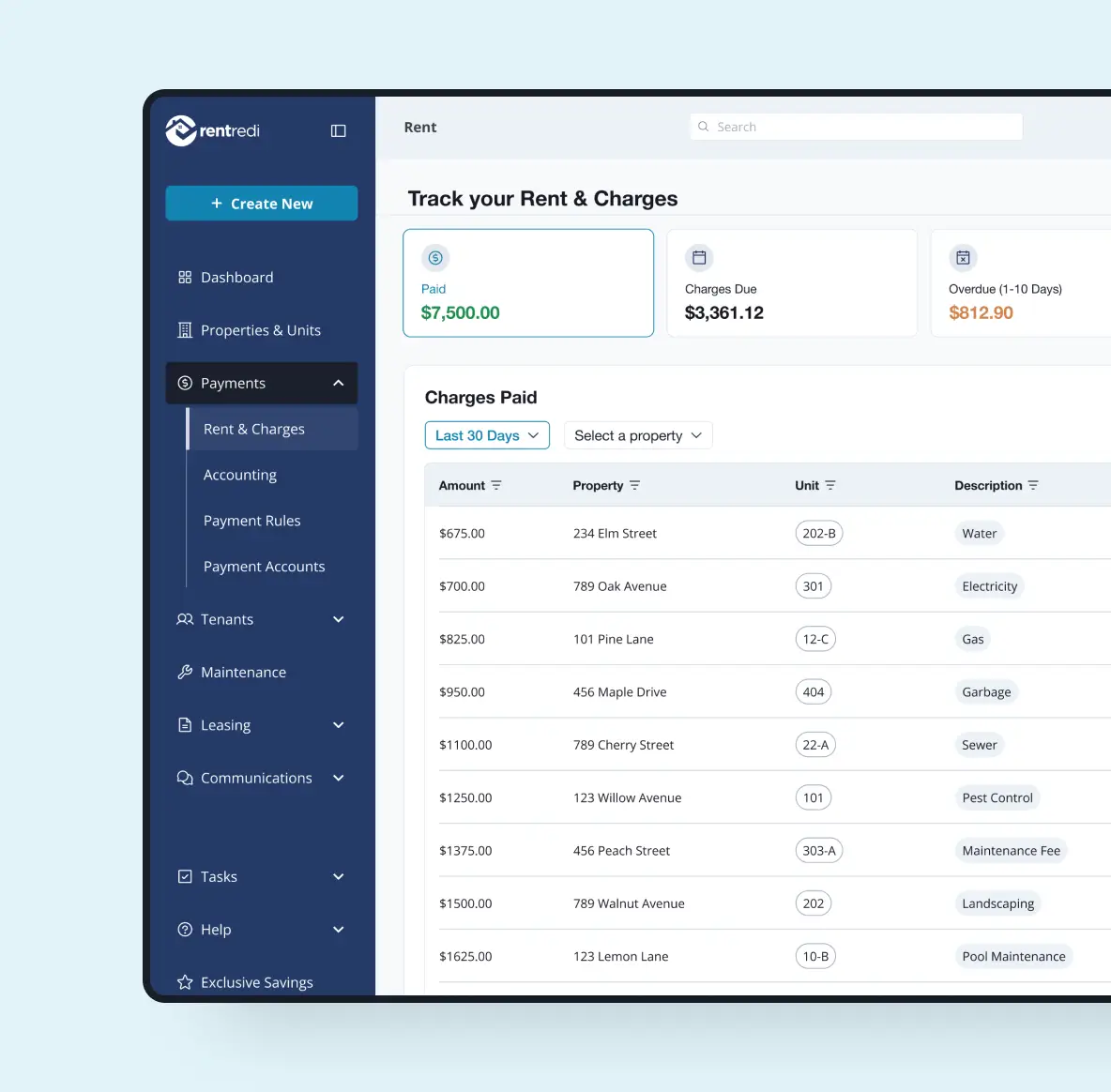
When evaluating a property management app for your rentals, consider whether it integrates mileage tracking with your broader property management workflow. Platforms like RentRedi offer all-in-one rental property management software that handles rent collection, tenant screening, maintenance coordination, and accounting, giving landlords a centralized system where financial data, including travel expenses, feeds into their overall rental property accounting software setup. That kind of integration means fewer disconnected tools and a cleaner paper trail at tax time.

If you are already using landlord bookkeeping software to manage income and depreciation across your properties, check whether it includes a mileage tracking feature or integrates with one. Having your mileage data live alongside your rent rolls, repair expenses, and depreciation schedules makes tax preparation dramatically simpler. The goal is a single source of truth for all your rental accounting software needs rather than a patchwork of disconnected spreadsheets and apps.

Reporting Your Mileage Deduction on Your Tax Return

Schedule E and Form 4562

Rental property income and expenses are reported on Schedule E (Form 1040), Supplemental Income and Loss. Your mileage deduction goes on the “Auto and travel” line under the expenses section for each property. If you claim any vehicle expenses, you must also complete Part V of Form 4562 (Depreciation and Amortization) and attach it to your return. Part V asks for details about the vehicle itself: when it was placed in service, total miles driven during the year, business miles driven, whether you have written evidence to support the deduction, and whether that evidence is contemporaneous. Answering “no” to the written evidence question is essentially telling the IRS you do not have a proper log.

Allocating Miles Across Multiple Properties

Landlords with several properties need to allocate mileage to each property individually on Schedule E. If you drove to Property A for an inspection and then continued to Property B for a repair, break the trip into segments. The miles from your home office (or the first property) to Property A go under Property A’s expenses. The miles from Property A to Property B go under Property B’s. Accurate allocation matters because each property has its own profit-and-loss calculation, and misallocated expenses can distort your reported income.

Mileage tracking is not glamorous. It will never be the reason you invest in real estate. But for landlords who drive to and from their properties regularly, the cumulative deduction is significant, often worth $1,500 to $4,000 or more per year, depending on your portfolio size and how frequently you visit your properties.

Mileage log for landlords supported by proper lease documentation as a tenant signs a rental agreement across from a property manager with a house model on the table

Maintaining a proper mileage log strengthens your entire tax position. Landlords who track mileage meticulously tend to keep better records across the board. Better records mean cleaner returns, fewer audit surprises, and faster preparation each filing season. A well-maintained rental property mileage signals to a tax preparer that you take your rental business seriously. The barrier to entry is remarkably low. A free app, five seconds per trip, and a year-end odometer photo. That is all it takes to claim every mile you are entitled to and defend it if challenged. Whether you track with a simple spreadsheet, a dedicated mileage tracking app, or a full property management software for small landlords, like RentRedi, the key is choosing a method and sticking with it from January through December.

Sources: