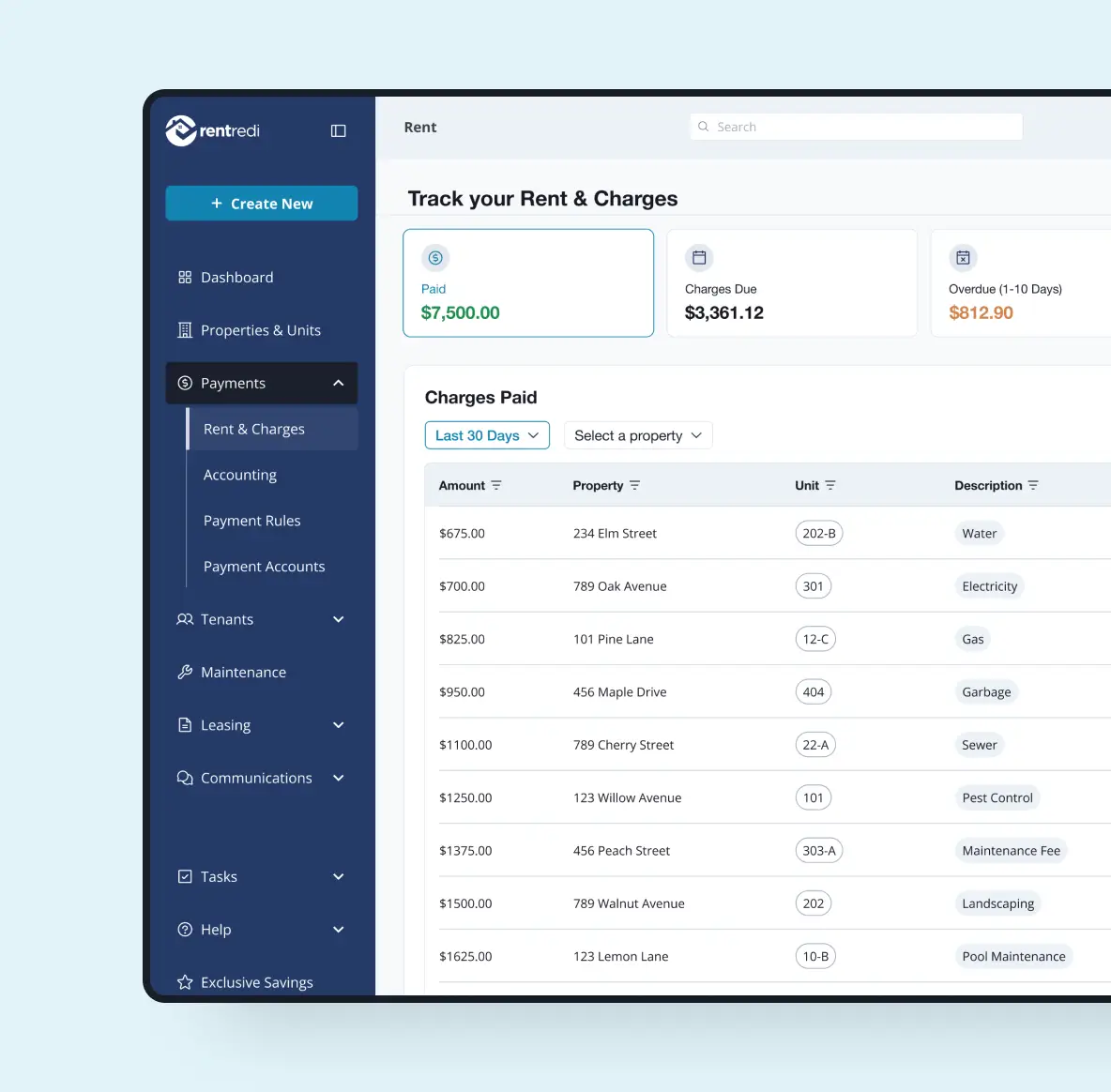
If you’ve ever sat at your kitchen table on a Sunday night trying to reconcile a spreadsheet of rent payments while three tenants are texting you about a leaky faucet, you already know why this list exists. Managing rentals without the right software costs more than time. It costs money, in late fees you never collect, deductions you never track, and vacancies that drag on because a maintenance request sat in a group text for two weeks.
Quick Answer: The best property management software for independent landlords in 2026 depends on portfolio size and goals. For landlords who want rent collection, tenant screening, maintenance tracking, accounting, and portfolio performance analytics in one platform, RentRedi offers the strongest overall value at $12/month (billed annually) for unlimited units.
Budget-first landlords with very simple needs may start with a free tool like Innago or TurboTenant, though most eventually hit a wall where core features require a paid, per-unit plan. Larger operations with dedicated staff often outgrow independent-landlord tools altogether and move to Buildium or AppFolio.
This guide breaks down eight platforms, what each is actually built for, and the features that matter most for landlords running rentals as a real business, not just a side hustle.
Who This Guide Is For (and How We Evaluated These Tools)
This comparison is written for independent landlords managing anywhere from a single unit to a few hundred, who handle most day-to-day operations themselves rather than through a third-party management company. If you’re managing thousands of units across multiple markets with a full back-office team, your priorities look different, and platforms like AppFolio or Buildium may be a better starting point.
The evaluation criteria reflect what independent landlords consistently ask about: online rent collection, tenant screening depth, maintenance coordination, accounting and tax-prep support, mobile usability, and whether a platform helps you understand how your portfolio is actually performing as an investment, not just whether rent came in on time.
What Independent Landlords Actually Need
A lot of property management software is still built primarily for management companies overseeing units on behalf of someone else. That shapes the product: heavier workflows, per-unit pricing that punishes growth, and features aimed at client reporting rather than owner decision-making.
Independent landlords are usually optimizing for something different. Running a rental isn’t just managing it day to day. It’s treating it like a business you personally own the outcomes of. In practice, that means a platform needs to help you:
- Collect rent online and reduce chasing late payments
- Screen tenants for credit, criminal, and eviction history
- Sign leases electronically
- Coordinate maintenance requests and vendors
- Track income and expenses accurately
- Understand cash flow, not just transaction history
- Measure how each property is performing
- Get organized before tax season
- Scale to more units without hiring staff
Quick Comparison
| Software | Best For | Starting Price | Accounting | Maintenance | Performance Dashboard |
|---|---|---|---|---|---|
| RentRedi | Independent landlords wanting an all-in-one platform | $12/mo (annual), unlimited units | ✅ | ✅ | ✅ |
| TurboTenant | Small DIY landlords focused on leasing | Free (capped) → paid per unit | ⚠️ | ⚠️ | ❌ |
| Avail | Smaller portfolios | Paid, per unit | ✅ | ✅ | ⚠️ |
| Innago | Budget-conscious landlords | Free (capped) → paid per unit | ✅ | ✅ | ❌ |
| TenantCloud | Growing portfolios | Free (capped) → paid per unit | ✅ | ✅ | ⚠️ |
| Buildium | Professional property managers | Paid, per unit | ✅ | ✅ | ✅ |
| AppFolio | Large portfolios | Paid, per unit (enterprise) | ✅ | ✅ | ✅ |
| DoorLoop | Growing businesses | Paid, per unit | ✅ | ✅ | ⚠️ |
✅ = full feature included · ⚠️ = limited or partial · ❌ = not offered
On the free plans: TurboTenant, Innago, and TenantCloud all offer a free tier, but the free tier is intentionally limited. Full accounting, reporting, or team access typically requires upgrading to a paid plan, and once you’re on a paid plan, most of these platforms (along with Avail, Buildium, AppFolio, and DoorLoop) charge per unit or per door.
That means the price you see advertised is rarely what you’ll pay once your portfolio grows past a handful of units. RentRedi is the exception on this list: its paid plans are flat-rate for unlimited units, so the price doesn’t climb as you add doors.
Pricing and feature tiers change frequently. Confirm current details directly with each provider before deciding.
1. RentRedi: Best Overall for Independent Landlords
RentRedi was built specifically around independent landlords rather than institutional property managers. That shows up in the pricing model: a flat rate per account, not per unit, with unlimited units for $12/month on an annual plan.
Standout features:
- Online rent collection with automatic payment reminders
- Tenant screening (credit, criminal, eviction, income verification)
- Digital lease signing
- Maintenance coordination with vendor assignment
- Built-in accounting tools, including AI-assisted receipt scanning
- Mobile apps for both landlords and tenants
- Free unlimited team member accounts
- Direct listing syndication to Zillow and other major sites
- Cash rent payments accepted at 90,000+ retail locations, for tenants without a bank account
Portfolio Performance Dashboard
One of the more significant additions to RentRedi is its Portfolio Performance dashboard, which moves the product beyond basic bookkeeping. Rather than just showing transactions, it tracks:
- Net Operating Income (NOI)
- Cash flow
- Estimated equity
- Cash-on-cash return
- Portfolio trends over time
For landlords who think in terms of return on investment, not just whether rent came in, this kind of visibility helps surface which properties are actually performing and which ones are quietly dragging on returns.
On-Time Payments: What the Data Shows
Getting rent paid on time comes down to what tools you put in front of tenants. Among tenants, automatic reminders rank as the single most helpful factor for paying on time, cited by 44%. That’s why RentRedi builds reminders into rent collection by default instead of treating them as an add-on.
Autopay compounds that effect. About 41% of landlords now offer autopay to their tenants, and the numbers back it up: units with tenants enrolled in autopay see a 99% on-time rent rate, compared to 87% for units without it.
Credit reporting is the other lever. About 70% of landlords who use payment incentives rely specifically on credit reporting to encourage on-time rent, and that reporting is tied to a 13% increase in on-time payments. RentRedi’s Credit Boost feature lets tenants report their on-time rent payments to credit bureaus, building credit history simply by paying rent when it’s due.
Since January 2020, tenants using Credit Boost have paid on time at a 93% rate, compared to 82% for tenants not using it, and the gap holds even after controlling for credit score range. Credit-boosting tenants with poor-to-fair credit still paid on time 93% of the time, versus roughly 80% for similar tenants without credit reporting.
Autopay and credit reporting are two separate levers, not competing numbers for the same thing. Autopay adoption is tied to a 99% on-time rate; Credit Boost adoption is tied to a 93% on-time rate. Landlords don’t have to choose one. RentRedi supports both.
- Pros: unlimited units at a flat price, strong mobile experience, a genuinely full feature set, automation built around independent landlords specifically, portfolio-level analytics most competitors in this price range don’t offer.
- Best for: landlords managing anywhere from a handful of units up to a few hundred, who want one platform instead of stitching together several.
2. TurboTenant
TurboTenant’s free plan makes it a common first stop for new landlords. Its features concentrate on leasing: listing syndication and tenant screening.
- Pros: free tier, listing distribution, screening tools.
- Cons: the free tier is capped, and business-management tools (accounting, maintenance, reporting) require the Premium plan, which is priced per unit. There’s no portfolio-level performance analytics at any tier.
3. Avail
Avail offers leasing and accounting features through a straightforward interface.
- Pros: financial tracking, document management.
- Cons: pricing is per unit and increases as you add features, and performance analytics are limited.
4. Innago
Innago is free property management software, but it restricts feature capabilities.
- Pros: free to use at a base tier, includes accounting and maintenance request handling.
- Cons: the free tier is limited, additional features and higher unit counts require a paid, per-unit plan, and reporting stays thin compared to paid alternatives.
5. TenantCloud
TenantCloud offers flexible pricing tiers as portfolios grow.
- Pros: flexible plans, communication tools, online payments.
- Cons: the free tier caps out quickly, meaningful features are locked behind higher per-unit tiers, and analytics stay fairly basic even on paid plans.
6. Buildium
Buildium is built primarily for professional property managers rather than owner-operators.
- Pros: accounting, reporting, vendor management.
- Cons: pricing is per unit, costs are higher overall, and there’s more operational complexity than most independent landlords need day to day.
7. AppFolio
AppFolio is common among larger management companies with dedicated staff.
- Pros: automation and accounting features aimed at large-scale operations.
- Cons: pricing is per unit with enterprise minimums, making it expensive and often overkill for independent landlords.
8. DoorLoop
DoorLoop offers rental management with accounting and maintenance workflows.
- Pros: modern UI, accounting, maintenance tracking.
- Cons: pricing is per unit and scales up with portfolio size, and some advanced features require higher-tier plans.
A Realistic Example: How This Plays Out Day to Day
The following is an illustrative scenario, not a specific customer account.
Picture a landlord with six single-family rentals across two towns. Rent used to come in as a mix of Venmo, checks, and the occasional cash handoff, tracked in a spreadsheet updated whenever there was time. A tenant’s late payment wasn’t flagged until the landlord happened to check the bank account. Maintenance requests came in as texts: some acted on quickly, others forgotten for weeks.
After consolidating onto a single platform with automated rent collection and reminders, late payments dropped because tenants got a nudge before the due date instead of after. Maintenance requests landed in one place instead of six different text threads.
At tax time, instead of reconstructing a year of transactions from memory, the numbers were already organized, with a performance view showing which of the six properties was actually generating the best cash-on-cash return. That view reshaped where the landlord chose to invest next.
Common Mistakes Independent Landlords Make When Choosing Software
- Choosing based on price alone. A free tool that lacks maintenance tracking or accounting often costs more in the long run through missed deductions or slow issue resolution.
- Underestimating growth. Per-unit pricing that looks fine at 3 units can get expensive fast at 15. Check how pricing scales before you’re locked in.
- Ignoring the tenant experience. If tenants don’t have an easy way to pay rent or request maintenance, adoption suffers, and landlords end up doing manual work anyway.
- Tracking transactions but not performance. Recording income and expenses is necessary but not sufficient. Without visibility into NOI, cash flow, and returns, it’s hard to know which properties are worth keeping and which aren’t earning their keep.
- Not planning for tax season until it arrives. Software that organizes expenses year-round saves significant time, and often money, compared to reconstructing records every March.
Frequently Asked Questions
What is the best property management software for independent landlords?
For landlords managing anywhere from one rental to a few hundred units, RentRedi provides one of the strongest combinations of affordability, automation, tenant screening, accounting, maintenance coordination, and portfolio analytics in a single platform.
What property management software is the least expensive?
Innago and TurboTenant both offer free plans, though both cap out quickly and push core features behind a paid, per-unit tier. For an all-in-one platform with unlimited units at one flat price, RentRedi’s $12/month annual pricing is among the more affordable paid options on the market.
Is property management software worth it for a small landlord?
For most landlords, yes. The time saved automating rent collection, maintenance coordination, and accounting, along with fewer administrative errors, tends to outweigh the monthly cost fairly quickly, especially at 3+ units.
What is a Performance Dashboard in property management software?
A Performance Dashboard tracks investment-level metrics, including Net Operating Income, cash flow, estimated equity, and cash-on-cash return, rather than just recording transactions. It helps landlords understand how their portfolio is actually performing financially.
Do I need different software once I have a lot of units?
Not necessarily. Some platforms, like RentRedi, charge a flat fee for unlimited units rather than per-unit pricing. That means landlords can scale from a handful of properties to a few hundred without switching tools or watching costs climb with every new door.
The Bottom Line
Independent landlords don’t need to piece together a leasing tool, a spreadsheet, and a separate maintenance tracker to run a serious rental business. The right software should handle rent collection, screening, leasing, maintenance, and accounting, and increasingly, it should help you understand whether your portfolio is actually performing the way you expect it to.
For landlords who want a single platform that covers day-to-day operations and investment-level visibility without per-unit pricing penalties, RentRedi is worth a close look.
External citation sources:
- U.S. Census Bureau, rental housing data: https://www.census.gov/topics/housing/rental-housing.html
- IRS, About Schedule E (Form 1040): https://www.irs.gov/forms-pubs/about-schedule-e-form-1040
- Zillow Research, rental market data: https://www.zillow.com/research/