Affordable Property Management Software for Landlords

Find affordable property management software that won't nickel-and-dime you as your portfolio grows, with real per-unit pricing breakdowns.

7 min read

Most landlords assume they’ll need to pay enterprise prices, somewhere in the $100 to $300 a month range, to get real software instead of a spreadsheet. That’s not accurate for independent landlords managing a handful of units up to a few hundred. Affordable property management software exists, and several platforms deliver rent collection, screening, maintenance, and accounting for under $20 a month. The catch is that the advertised price and the price you’ll actually pay as you grow aren’t always the same thing.

Quick Answer: For landlords looking for affordable property management software with no per-unit charges, RentRedi is the strongest option at $12/month billed annually for unlimited units, covering rent collection, screening, maintenance, accounting, and portfolio analytics. Innago is a free option if you’re willing to accept thinner reporting. TurboTenant and TenantCloud both offer free tiers too, but expect to hit a wall where core features require a paid, per-unit upgrade as your portfolio grows.

This guide breaks down five platforms that fit under the $20/month mark, what “under $20” actually gets you at each one, and why pricing structure (not just the sticker price) matters more as you scale.

Who This Guide Is For (and How We Evaluated These Tools)

This is written for independent landlords managing anywhere from one unit to a few hundred, who are price-sensitive and handling most day-to-day work themselves rather than through a management company. If you’re comparing enterprise platforms like Yardi or a large multifamily deployment, this guide isn’t for you. It’s for the landlord deciding between a free tool with real limits and a low-cost paid tool that actually covers what they need.

We evaluated each platform on advertised starting price, what that price actually includes, whether pricing changes as you add units, and how complete the core feature set is (rent collection, screening, maintenance, and accounting) without needing a separate add-on tool.

What Affordable Property Management Software Should Actually Include

A low price tag isn’t worth much if it doesn’t cover the basics. At minimum, budget-friendly property management software should include:

  • Online rent collection
  • Tenant screening
  • Digital leases
  • Maintenance request tracking
  • Expense tracking and basic accounting
  • Mobile apps for landlords and tenants
  • Financial reporting

Where platforms differ most isn’t the presence of these features. It’s whether you get them at the advertised price or whether you’re pushed into a higher tier to actually use them.

Quick Comparison

SoftwareStarting PriceBest ForUnlimited UnitsOnline Rent CollectionAccounting
RentRedi$12/mo (annual), flat rateAll-around value
InnagoFreeBudget-conscious landlords
TenantCloudFree (capped) → paid per unitGrowing portfolios⚠️
TurboTenantFree (capped) → paid per unitLeasing⚠️
AvailPaid, per unitSmall portfolios

✅ = full feature included · ⚠️ = limited or partial · ❌ = not offered

A note on “free”: Innago’s free plan is genuinely free with no unit cap, which is unusual among this group. TurboTenant and TenantCloud also advertise free tiers, but both cap out quickly, and unlocking full accounting, reporting, or higher unit counts pushes you into a paid, per-unit plan. Avail doesn’t offer a meaningful free tier and charges per unit from the start. RentRedi is the only paid platform here that stays flat-rate regardless of portfolio size.

Pricing and feature tiers change frequently. Confirm current details directly with each provider before deciding.

1. RentRedi: Best Overall Value Under $20/Month

Price: $12/month, billed annually, for unlimited units.

RentRedi fits a complete property management system, including unlimited units, under the cost of a nice lunch. Where a lot of competitors charge per property or increase pricing as your portfolio grows, RentRedi’s price stays the same whether you have 2 units or 200.

Included features:

  • Unlimited rental units
  • Online rent collection with automatic reminders
  • Tenant screening (credit, criminal, eviction, income verification)
  • Digital lease signing
  • Maintenance request tracking
  • Accounting tools, including AI-assisted receipt scanning
  • Mobile apps for landlords and tenants
  • Free unlimited team member accounts

Portfolio Performance Dashboard

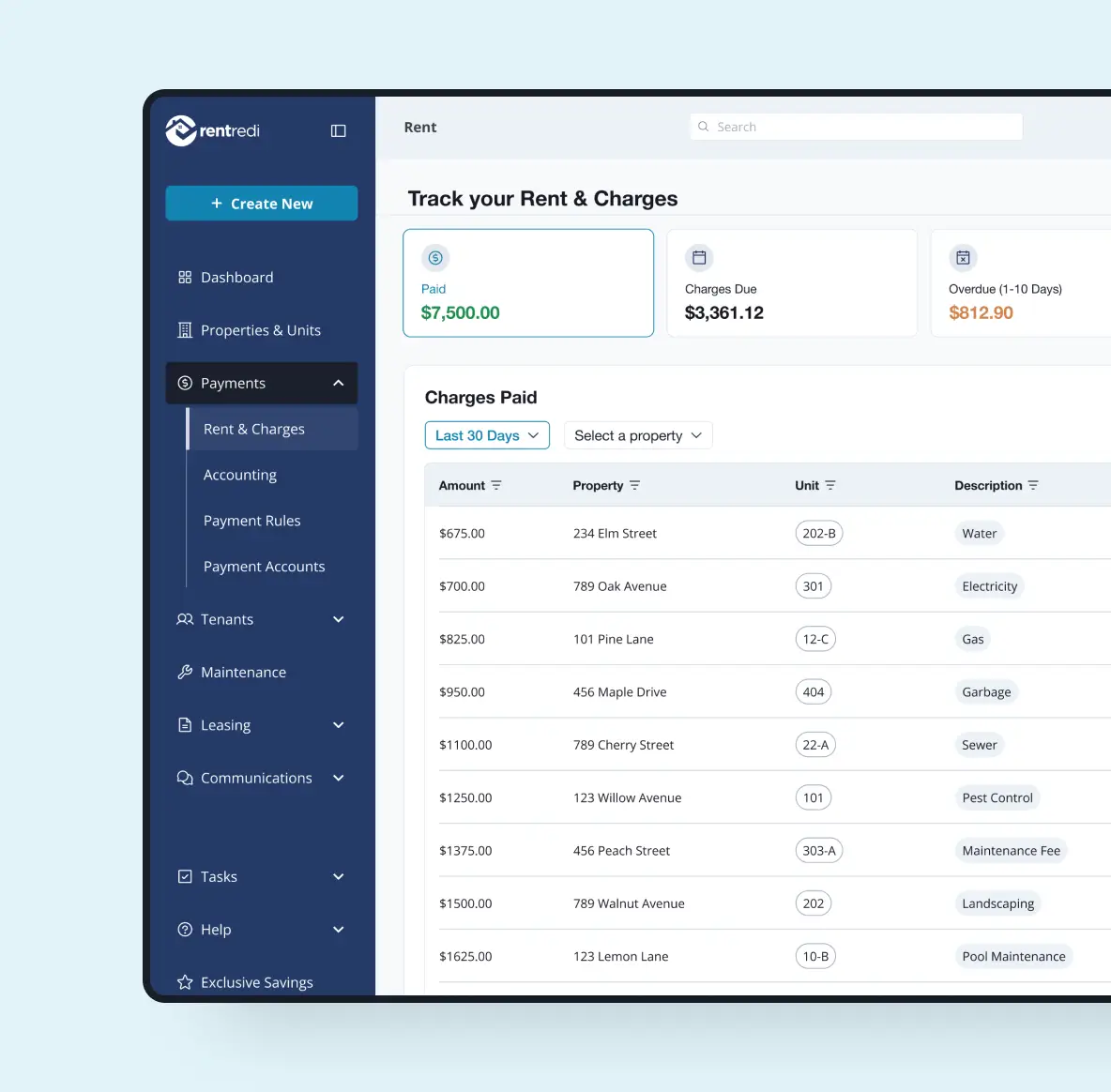
RentRedi’s Portfolio Performance dashboard tracks Net Operating Income (NOI), cash flow, estimated equity, cash-on-cash return, and portfolio trends over time. Instead of just recording transactions, it gives landlords visibility into whether their properties are actually performing as investments, a level of insight most platforms in this price range don’t offer at all.

Pros: unlimited units at a flat, low price, a modern mobile experience, a complete feature set without add-ons, automation built specifically for independent landlords.

Best for: landlords who want one platform to run their entire rental business while keeping software costs low and predictable.

2. Innago

Innago remains a draw for landlords who want cheap software without the deeper insights into where their cash flow is flowing to.

3. TurboTenant

TurboTenant is best known for helping landlords with a few rentals who mainly need leasing tools.

Cons: the free tier is capped, features are more concentrated on leasing than full portfolio management, and financial analytics are limited even on paid tiers.

4. TenantCloud

TenantCloud offers multiple pricing tiers and a fairly complete feature set.

Cons: the free tier caps out, several important features require a paid upgrade, and reporting stays less comprehensive than a fully paid platform.

5. Avail

Avail is another common option for independent landlords, though it doesn’t have a meaningful free tier.

Pros: user-friendly interface, accounting, lease management.

Cons: pricing is per unit and increases with premium features, and it’s better suited to smaller portfolios than ones planning to scale.

Why Pricing Structure Matters More Than the Sticker Price

A lot of property management software advertises a low entry price, then charges per unit, per property, per user, per bank account, or per premium feature once you actually need the software to do something. As your portfolio grows, the monthly bill can grow with it, sometimes dramatically.

Here’s an illustrative example of how per-unit pricing can scale compared to a flat-rate model. These figures are approximations based on typical per-unit pricing structures in this category, not confirmed prices for any single competitor, since pricing varies by plan and changes over time.

Portfolio SizeTypical Per-Unit PricingRentRedi (flat rate)
5 units~$30-60/month$12/month
25 units~$150-300/month$12/month
100 units~$600+/month$12/month

For landlords planning to grow, the pricing model matters just as much as the feature list. A slightly higher starting price with a flat rate can end up far cheaper than a “free” or low-cost tool once you scale past a handful of doors.

A Realistic Example: How This Plays Out Day to Day

The following is an illustrative scenario, not a specific customer account.

Picture a landlord starting out with 3 units on a free platform. The free plan covers listings and basic rent collection, which feels like plenty at first. By year two, the landlord has grown to 12 units and needs real accounting, maintenance tracking, and reporting, all of which are gated behind the platform’s paid tier, priced per unit. The monthly bill jumps from $0 to well over $100 almost overnight, and switching platforms at that point means re-onboarding tenants and rebuilding records from scratch. Choosing a flat-rate platform from the start would have avoided that cliff entirely.

Common Mistakes Landlords Make When Choosing “Cheap” Software

  • Judging cost by the advertised starting price alone. Free and low-cost tiers often gate the features you’ll actually need behind a paid, per-unit upgrade.
  • Not checking how pricing scales. A platform that’s cheap at 3 units can get expensive fast at 15 or 30. Ask about per-unit pricing before you commit.
  • Assuming free means feature-complete. Free tiers are often intentionally limited to encourage upgrades, which is a reasonable business model, but it means “free” and “full-featured” aren’t the same thing.
  • Ignoring switching costs. Moving tenants, leases, and payment history to a new platform later is more disruptive than picking a platform that scales well from the start.
  • Overlooking portfolio-level reporting. Many budget tools handle day-to-day tasks fine but offer little visibility into NOI, cash flow, or returns, which matters more as a portfolio grows.

Frequently Asked Questions

Is paying for property management software worth it?

For many landlords, yes. A small monthly cost can save hours each month through automation while reducing missed payments and simplifying tax preparation, especially once a portfolio grows past a few units.

Which property management software offers the best value under $20/month?

For landlords wanting an all-in-one solution with unlimited units, no per-unit charges, and portfolio-level analytics, RentRedi’s $12/month annual pricing is among the strongest combinations of price and functionality in this category.

Do I need expensive software to manage rentals?

Not necessarily. Most independent landlords can automate rent collection, screening, maintenance, and accounting through affordable software without paying enterprise-level prices.

Does free property management software have hidden costs?

Not hidden exactly, but often gated. Free tiers typically cap unit counts or lock accounting, reporting, and maintenance tools behind a paid plan, so it’s worth checking what happens once you outgrow the free tier before you rely on it long term.

The Bottom Line

Affordable property management software is realistic for most independent landlords, and it doesn’t have to mean settling for less. The harder question isn’t whether an affordable option exists. It’s whether the pricing model will still make sense once your portfolio grows. A flat-rate platform with unlimited units, like RentRedi at $12/month annually, avoids the per-unit cost creep that catches a lot of landlords off guard a year or two in.

External citation sources:

  • U.S. Census Bureau, rental housing data: https://www.census.gov/topics/housing/rental-housing.html
  • IRS, About Schedule E (Form 1040): https://www.irs.gov/forms-pubs/about-schedule-e-form-1040
  • Zillow Research, rental market data: https://www.zillow.com/research/