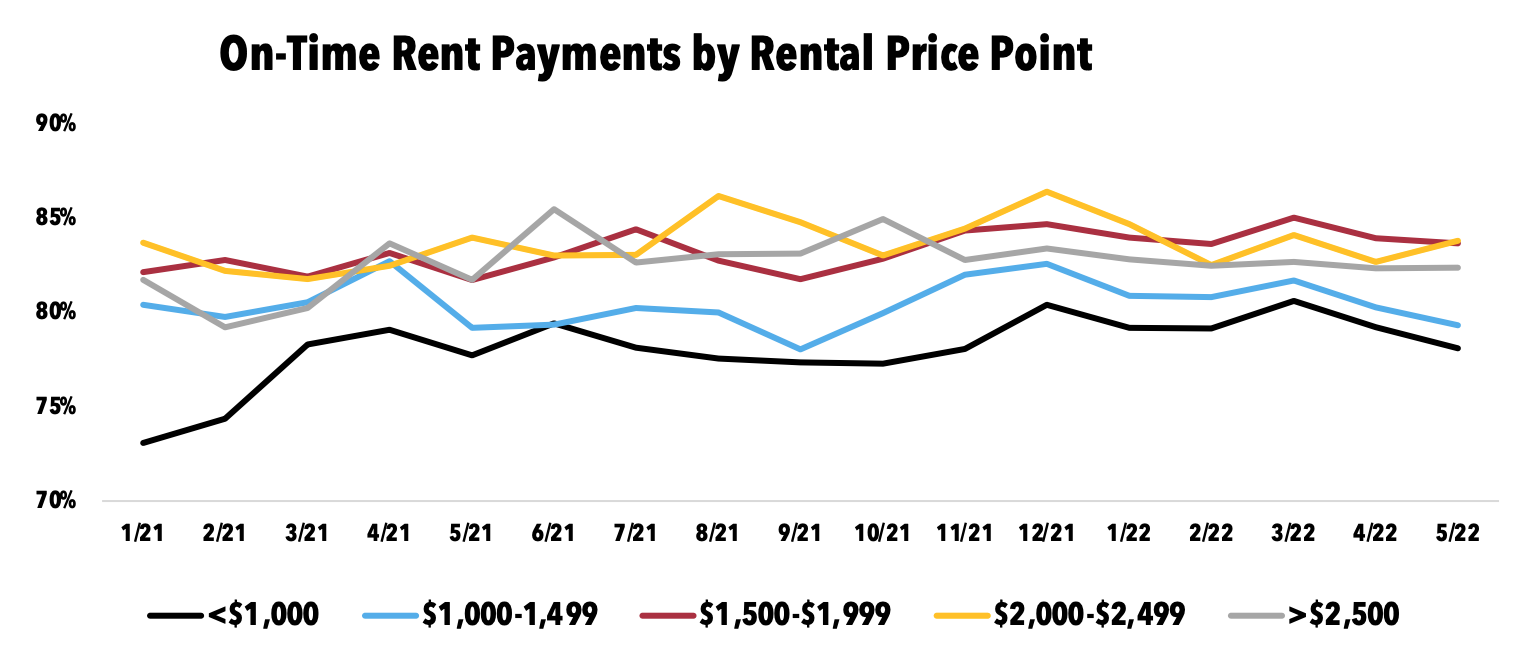
May’s Independent Landlord Rental Performance Report (data provided by RentRedi & analyzed by Chandan Economics) shows that after reaching a high of 80.6% in March, on-time payment rates have dropped in both April and May.
Highlights
- On-time rent payments dropped to 78.1%
- 2-4 family rentals maintain the highest on-time rental payments at 81.1%
- Mid-priced rentals ($1,500-$2,499) continue to outperform all other price points.
Report Methodology and Scope
The May 2022 Independent Landlord Rental Performance Report is designed to provide readers with clear context on how the findings were assembled and what they are meant to measure. Before interpreting the monthly results, it helps to understand the report’s data sources, coverage, methodology, and intended purpose.
- Data Sources and Analysis Partnership: The report is built from rent payment data provided by RentRedi and analyzed by Chandan Economics. That combination matters because it pairs real rental transaction data with economic analysis to produce a clearer picture of payment behavior. The report does not rely on anecdotal observations or isolated examples. Instead, it uses a defined data process that supports repeatable monthly reporting and helps readers understand where the findings come from and why they can be treated as a reliable industry reference.
- Report Coverage and Sample Scope: This report focuses on independent landlord rental units and follows rent collection performance over time. It is intended to reflect a specific segment of the rental market rather than the professionally managed sector alone.
- Methodology and Measurement Approach: The report measures rent collection through on-time payment rates, using monthly snapshots to track short-term changes and broader trends. This approach makes it possible to compare the current month with prior months and identify whether performance is improving, holding steady, or weakening. The methodology is centered on payment timing, which keeps the analysis focused and consistent.
- Intended Use and Benchmarking Purpose: By presenting consistent data over time, this helps readers compare current performance against historical patterns and broader market behavior. That makes it useful for interpretation, planning, and general market awareness.
This framing gives readers the background they need to interpret the report accurately without drifting into performance results or landlord strategy.
Landlord Growth Strategies
Rental performance data is most useful when landlords can use it to make better day-to-day decisions. Growth comes from using the right tools to reduce friction and spot problems early. The strategies below focus on practical ways to strengthen operations, improve cash flow, and use rental data more effectively:
- Use Rent Collection Tools to Improve Cash Flow: Reliable rent collection starts with making payment easy for tenants and consistent for landlords. Digital payment tools and reminders can reduce late payments and improve collection rates over time. Landlords can also use payment history to identify recurring issues and respond early.
- Track Performance Trends to Make Better Decisions: Landlords can improve their rental business by reviewing performance data regularly rather than waiting for major problems to emerge. Tracking on-time payment trends, month-over-month changes, and property-level results helps identify which units need attention. Data makes it easier to compare performance across properties and spot patterns that may affect revenue. With that insight, landlords can make more informed decisions about pricing, tenant support, and long-term planning.
- Use Tenant Screening to Reduce Payment Risk: Strong tenant screening helps landlords select renters more likely to pay on time and stay longer. Reviewing application data, credit history, and background checks can lower the risk of missed rent and turnover. Screening tools are especially valuable when combined with other business data, since they help landlords understand not just who qualifies, but who is likely to perform well over time. Better tenant selection supports more stable income and less operational stress.
- Simplify Maintenance and Lease Management: When landlords can track repair needs, renewal dates, and lease terms digitally, they spend less time on manual follow-up and avoid costly oversights. Centralized management tools give landlords a clearer view of property health and help them respond faster to business needs.
Independent landlords can make smarter decisions and build a stronger rental business over time.
Property Type Performance Shows Which Rental Segments Are Most Resilient
The strongest-performing segment was 2–4 family rentals, which posted an on-time payment rate of 81.1%. That result matters because it shows smaller multifamily properties may have an advantage in rent collection during softer market periods. Instead of treating all rentals as a single group, this type of breakdown reveals which housing structures are holding up better and which may be more vulnerable to missed payments. Property type is a meaningful variable in performance analysis, not just a descriptive label. Better outcomes in one segment may reflect differences in renter profiles, unit sizes, or market positioning, while weaker outcomes in another segment may signal greater pressure in that segment. The analysis of rental property performance by property type highlights how different rental types may perform in the market.
Regional Performance Patterns Can Help Landlords Spot Stronger And Weaker Markets
Geographic differences can meaningfully change how rental properties perform.
- Northeast Market Conditions: The Northeast can be useful for showing how higher housing costs and dense urban rental markets affect payment performance. If on-time rent collection is stronger or weaker in this region, it may signal differences in tenant affordability or competitive rental demand.
- Southern States May Show More Variation Across Local Markets: The South often contains a wide mix of suburban, urban, and smaller-town rental markets, so performance can vary significantly from one state to another.
- Midwest Results Can Highlight Stability: If collections are relatively strong in this region, it may indicate that lower housing costs are reducing tenants’ payment stress. If results are weaker, that could suggest local job market or income pressures are affecting rent behavior.
- Western Markets May Show The Strongest Regional Contrasts: The West often produces the clearest regional contrasts because it includes both high-cost urban markets and more moderate smaller markets.
It gives landlords a better way to compare their own market against broader trends and adds an important layer of context to the monthly results.
Year-Over-Year Rental Performance Context
Year-over-year rental performance shows whether independent landlords are improving or slipping compared with the same period last year, which helps separate short-term monthly noise from a more meaningful trend. The key comparison should be the current on-time payment rate against May 2021, not just against April 2022 or March 2022. That year-over-year lens is important because rent collection can be influenced by seasonal shifts, billing cycles, and one-off events that may distort month-to-month results. If current on-time payments are lower than they were a year ago, it suggests households may be facing tighter budgets or greater payment stress. Even if recent monthly changes appear modest. If the current reading is higher, it indicates stronger renter stability and better collections than the same point last year. This context also helps readers understand whether the improvement or decline is isolated or part of a longer pattern. Year-over-year changes are especially useful because they show how performance is moving relative to a stable seasonal benchmark.
Full Landlord Rental Performance Report
Get the full report & analysis for May here.
About the Report Authors
One must understand the background information about the organizations involved. RentRedi is property management software that provides landlords and investors with the tools they need to manage their properties. Our platform not only helps independent landlords collect rent more easily but also lets you list properties, screen tenants, sign leases, and manage maintenance. Chandan Economics analyzes the information and produces a monthly market report. That division of roles helps readers understand that the results are based on real rental activity rather than estimates or anecdotal commentary. It also shows that the report reflects both operational data and economic expertise, making the findings more transparent and trustworthy for landlords, investors, and other readers evaluating independent rental performance.