Dynamic pricing helps landlords earn more by adjusting rent based on real-time demand, seasonality, vacancies, and renter activity. Rather than setting one fixed price for the year, you update rent as market conditions change. This helps reduce vacancy time and improve occupancy, even capturing higher rent when demand is strong.
As you may or may not be aware, traditional pricing usually relies on comps and yearly updates. This often misses fast market changes like seasonality, job growth, and new supply. But with dynamic pricing, you can adjust faster. This helps reduce vacancies when demand is low and avoid underpricing when demand is high.
Keep reading to learn how to use dynamic pricing and market data to boost your rental income.
TL;DR
Key takeaways:
- Dynamic pricing reduces vacancy loss by responding to demand shifts in real time.
- Market data improves pricing accuracy and helps avoid underpricing or overpricing.
- Small, frequent pricing adjustments often outperform delayed or reactive rent cuts.
- AI and automation tools help landlords scale pricing decisions and stay consistent.
What Is Dynamic Pricing in Real Estate?
In real estate, dynamic pricing is the practice of adjusting rental rates based on current market conditions rather than sticking to a fixed annual price. It takes into account factors like demand, seasonality, local competition, vacancy rates, and renter behavior to set more responsive pricing. Instead of guessing a “right” rent once a year, landlords continuously update pricing as conditions change.
How Dynamic Pricing Helps Landlords Increase Rental Income
Dynamic pricing helps landlords earn more by aligning rent with real-time demand.
- When demand rises: Prices can increase to capture higher income.
- When demand slows: Small adjustments help reduce vacancy time and keep units occupied instead of sitting empty.
That said, here’s how it drives better results:
- Reduces vacancy loss: Faster adjustments help fill units sooner instead of waiting out long empty periods.
- Improves pricing accuracy: Rent reflects real market conditions instead of outdated comps or annual estimates.
- Increases revenue over time: Captures higher rent during peak demand while staying competitive during slower months.
This approach helps landlords balance occupancy and rent levels to maximize long-term income.
What Market Data Should Landlords Track?
Dynamic pricing runs on data. Better inputs mean better decisions. You don’t need a statistics background. Just a habit of checking the right signals regularly. That’s what it takes to have data-driven property management.
What to track:
- Local rent levels and their direction
- How long the units sit vacant
- Seasonal patterns month by month
- Employment and hiring trends
- New buildings coming online
- How your own listings perform (inquiries, tours, applications, conversion rates).
You can find much of this publicly:
- The Apartment List National Rent Report shows current trends and clear seasonal patterns (see the month-over-month rent growth in the U.S.):
- The Zillow Observed Rent Index tracks the trajectory by market.
- The Fed publishes rental vacancy rates through FRED.
- Local job numbers come from the Bureau of Labor Statistics.
- Google Trends can show search interest as a rough proxy for demand.
- AirDNA covers short-term rentals, but its seasonal analysis applies to long-term markets as well.
Gregor Emmian, Deputy Chief Digital Growth Officer at Rise, says that data-driven decision-making is essential for understanding shifting consumer demand and market behavior. Especially in competitive rental markets where timing and pricing directly affect occupancy and revenue.
Emmian explains, “The best landlords treat market data like a compass. They track employment, seasonal swings, all of it. That approach beats gut-feel pricing every time because it catches opportunities you’d otherwise miss.”
If you’ve ever cut rent after two quiet weeks and suddenly gotten three applications in a day, you’ve experienced the power of demand data. Dynamic pricing makes that proactive. Ultimately, the goal is to value your rental property to achieve a higher return on investment (ROI).
How To Build a Dynamic Pricing Strategy
You can start simple with a routine you can repeat: research, analyze, integrate, test. Here’s how:
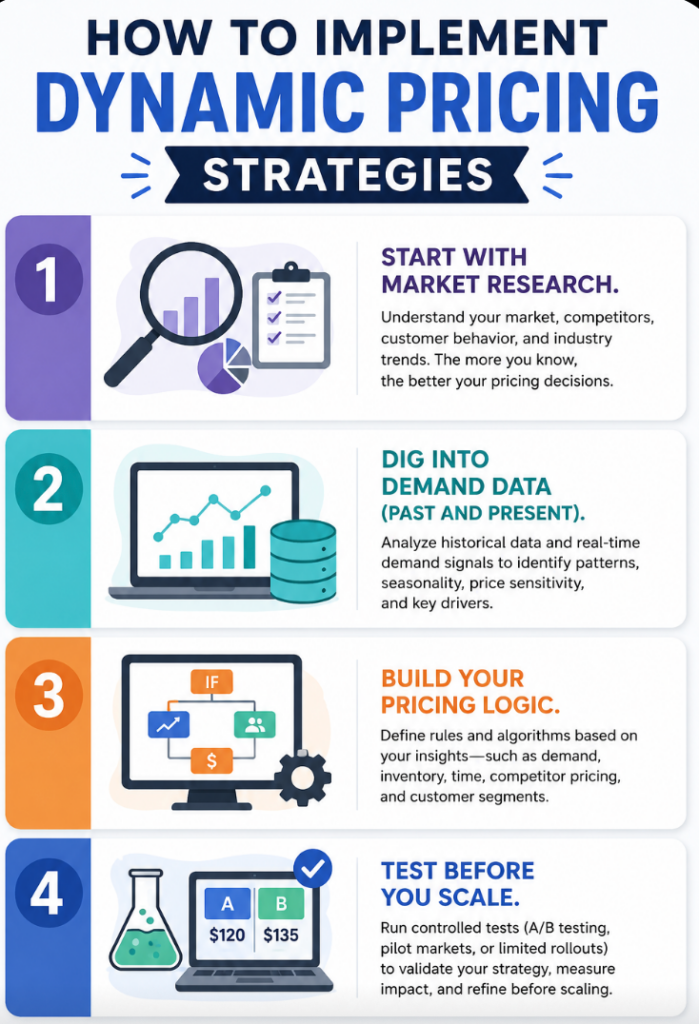
Image source: Generated via ChatGPT
1. Start with market research
Figure out who rents from you and why (unit type, location, amenities matter). Track your competitors’ listed prices weekly and note how long their units sit. Map your seasonal curve. Many markets peak late spring through summer, then cool. Don’t assume, so check it with a rent index or your own inquiry log.
2. Dig into demand data (past and present)
Pull 12 to 24 months of your records (inquiries, showings, applications, vacancy days, concessions, effective rent after discounts). Look for elasticity (when you raised or lowered rent, what happened to interest and time-to-lease?) That tells you pricing sensitivity.
3. Build your pricing logic
Set guardrails (minimum and maximum rent, how much you’ll move prices per week, simple vacancy triggers, etc.) Maybe if a unit sits for 10 days, you drop 1.5%. If you’re flooded with qualified leads in 48 hours, raise 1–2%. If you use pricing software, connect your data and configure the constraints. If you price manually, schedule weekly reviews, and stick to them.
4. Test before you scale
Run a 60 to 90-day pilot on some units. Compare them to units priced the old way. Track a few key metrics: occupancy, average vacancy days, effective rent, applications per listing, revenue per available unit (total rent collected divided by units available). Adjust your guardrails, not just the rent itself.
This isn’t about perfection on day one. You’re building a feedback loop. Markets change. Your system should, too.
Best Dynamic Pricing Tools for Landlords
You can run dynamic pricing with a spreadsheet and discipline. However, software makes it easier and more consistent. Whether you price your rentals digitally or collect rent payment online.
Options range from short-term rental tools like PriceLabs, Beyond, and Wheelhouse to multifamily revenue management systems that plug into property management platforms. Market analytics from Zillow, Apartment List, Yardi Matrix, and CoStar/STR feed the engines.
Look for tools with:
- Good data coverage in your specific submarket and property type
- Tech integration with your listing and leasing workflow to cut down on manual work
- A/B testing or pilot modes, allowing you to compare results safely
- Alerts or notifications for weird spikes or drops in inquiry volume to help you catch problems early
Jason Ledbetter, Operator at Jason Ledbetter, believes that pricing systems work best when automation is paired with real operational context on the ground.
In his view, software should handle the constant monitoring and adjustments. Meanwhile, operators stay focused on leasing performance and local market nuances.
Ledbetter says, “Automated pricing tools are most effective when they act as a real-time market scanner. They surface pricing opportunities and risks instantly, but the operator still defines the strategy…especially for positioning, concessions, and portfolio-level goals.”
Automated or manual?
- Automation scales and reacts fast.
- Manual control works fine for small portfolios or unusual properties.
Many owners blend both. Why? While algorithms set the pace, humans set the boundaries.
Take RentRedi’s smart property management platform. It not only lets you list your units and set dynamic prices for each, but also records and tracks your rent charges. Ultimately, this robust platform helps you maximize your rental income.
Common Dynamic Pricing Mistakes
Dynamic pricing helps. But it’s not automatic.
A few hurdles show up regularly:
- Data quality is extremely essential. Thin data in smaller markets produces noisy recommendations. Fill in the gaps with your own inquiries and tour data. As teams need to adjust their rhythm, posting one price per month won’t cut it. Make the transition easier with templates and a weekly routine. Tenants will ask why prices move, so be ready to explain clearly.
- Legal and ethical boundaries matter. Follow local rent control and fair housing laws. If you’re in a rent-controlled or stabilized area, review local rules carefully. Review the NMHC overview of rent control laws and core obligations under the Fair Housing Act. Document your inputs and reasoning. If a regulator or resident asks, you want a clean trail anyone can follow.
Learn from Brandy Hastings, SEO Strategist at SmartSites. She believes that dynamic pricing systems only work sustainably when transparency and compliance are built into the process from the start.
While the tools can automatically optimize rates, the real risk lies in how those recommendations are applied and communicated.
Hastings explains, “Dynamic pricing can improve performance. But it has to be implemented responsibly. Teams should be able to explain how pricing decisions are made. They should ensure fair housing compliance and maintain clear documentation.
Ultimately, transparency protects both the business and the residents.
Is Dynamic Pricing Legal?
Yes, dynamic pricing is generally legal in real estate because landlords are allowed to adjust rent based on market conditions, just like any other pricing strategy. However, it must still comply with local housing regulations and fair housing rules.
The key is that pricing changes should be based on legitimate market data. Not discriminatory or arbitrary factors.
In practice, it’s widely used by both individual landlords and large property management companies. The main requirement is transparency, consistency in methodology, and compliance with local regulations.
Here’s what landlords should keep in mind:
- Follow local rent laws. Some cities or regions may limit how often or how much rent can change.
- Avoid discriminatory pricing practices. Pricing decisions must comply with fair housing regulations.
- Document your pricing logic. Keep a clear record of the data and reasoning behind adjustment.
Dynamic pricing is legal when it follows market data. When it complies with housing laws. And when it is applied consistently.
Future Trends in Rental Pricing
We’re still early. The next wave will lean harder on machine learning and hyperlocal signals. However, it’s crucial to keep up with the rental market trends as early as now.
Take it from Zaheer Dodhia, CEO of Hummingbird International. He believes that rental pricing will increasingly shift from reactive adjustments to predictive systems that anticipate demand before it fully materializes.
Dodhia shares, “Machine learning is going to change how we price rentals by catching patterns humans miss. These systems will pull in hyperlocal data…like nearby construction, demographic shifts, even social media sentiment…to predict demand months out.
He wraps up, saying, “Operators who get comfortable with this early will have a clear competitive edge.”
Now, expect pricing engines that combine:
- Public feeds like permits and transit changes
- Private leasing data, like inquiry-to-application conversion
- Contextual signals like weather and event calendars
Also, expect more regulation and standards around algorithmic transparency. The best tools will pair smarter predictions with clearer explanations.
Ultimately, rental pricing is shifting from reactive adjustments to predictive, AI-driven systems that improve accuracy, efficiency, and long-term performance.
Maximizing Rental Income Through Dynamic Pricing
Dynamic pricing isn’t about charging the most possible rent. It’s about matching rent to demand. So, you lease faster and cut vacancies, keeping income as steady as possible.
The real benefit is simpler operations. With good market data and clear rules, pricing becomes a system. Not guesswork. That means fewer empty days and smoother leasing. More importantly, more predictable income.
The process is straightforward: use market data, set price limits, make small adjustments, and keep learning as conditions change.
If you’re starting out, test it on one property for 60–90 days. Track occupancy, vacancy days, and effective rent. Set basic floors and ceilings, adjust gradually, and stay consistent.
Done right, dynamic pricing helps you fill units faster, improve occupancy, and build more stable income over time.
Looking to maximize your rental income? RentRedi can help you manage pricing, marketing, tenant communication, and rent collection in one place. Sign up today to get started!
Frequently Asked Questions (FAQs)
What is dynamic pricing for landlords?
Dynamic pricing is a strategy where landlords adjust rent based on real-time market demand, seasonality, vacancy levels, and local data instead of setting a fixed yearly price.
Does dynamic pricing increase rental income?
Yes. It can increase income by reducing vacancy time, improving occupancy rates, and helping landlords capture higher rent when demand is strong.
How often should landlords adjust rent prices?
Most landlords review pricing weekly or monthly, depending on market activity. The key is making small, regular adjustments rather than large, reactive changes.
Is AI rental pricing legal?
Yes. AI-powered pricing tools are legal as long as they comply with local rent control laws and fair housing regulations. Pricing decisions must be based on market data, not discriminatory factors.
What data affects rental pricing?
Key data includes local rent trends, vacancy rates, seasonality, job growth, new supply, and performance data from your own listings (inquiries, tours, and lease speed).
What tools help automate rental pricing?
Common tools include platforms like PriceLabs, Beyond, Wheelhouse, and property management systems that integrate pricing with listing and leasing data. Market reports from Zillow and other analytics providers also support decision-making.