On-time rent payments from independent landlords inched up to 83.3% in January 2026, later revised to 82.8%, per RentRedi and Chandan Economics.
Quick Answer
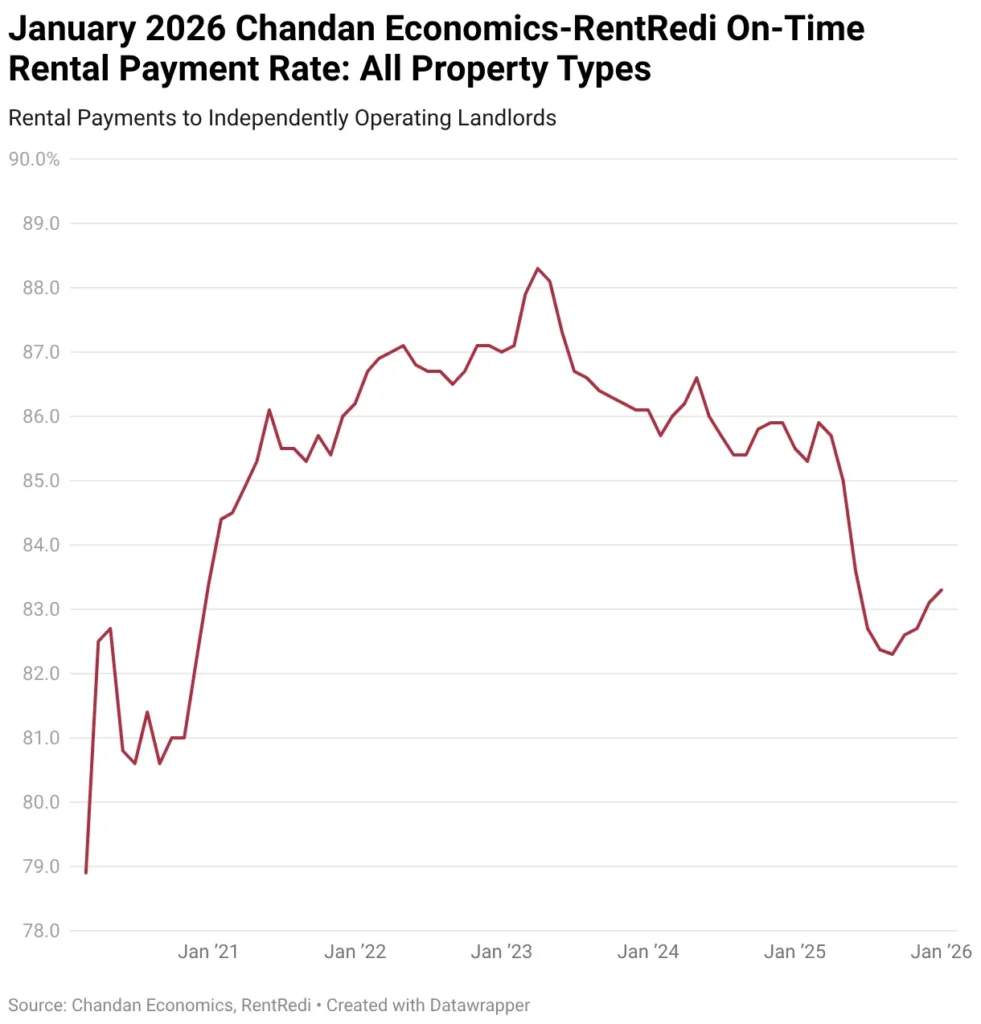
2026 started with another small step forward. On-time rent payments among independent landlords inched up to 83.3% in January 2026, 20 basis points (a fifth of a percentage point) above December’s revised reading and the fourth monthly gain in a row, according to the Chandan Economics-RentRedi Independent Landlord Rental Performance Report. RentRedi’s data shows on-time payments still 224 bps below a year earlier, the 30th straight month of annual declines. The Chandan Economics-RentRedi forecast full-payment rate, the share of rent that eventually gets paid even when it’s late, came in at 95.5%.
Small steps, but steady ones. Here is what RentRedi and Chandan Economics found for January 2026, and how it compares with the latest in our monthly rental performance reports.
Key Takeaways on Rental Performance for January 2026
The Chandan Economics-RentRedi report found five things:
- RentRedi’s data shows on-time rental payments in independently operated units inched higher to 83.3%, extending the gradual improvement since late 2025.
- RentRedi’s data shows on-time payments have fallen year over year for 30 consecutive months.
- RentRedi’s data shows full payment rates holding up, with 2025 averaging about 96.0% and beating the 2024 average.
- RentRedi’s data shows late payments, the main driver of underperformance, staying above 10% throughout 2025, with data at the time pointing to easing in early 2026.
- In RentRedi’s data, Western and Mountain states led, with Alaska (95.8%), New Hampshire (94.3%), South Dakota (93.8%), and Utah (92.9%) at the top.
What the January 2026 Data Shows
RentRedi’s data shows 83.3% of units paid their full rent on time in January, so roughly 1 in 6 units in RentRedi’s data missed the due date. On a 10-unit portfolio, RentRedi’s numbers work out to about two tenants paying late in a typical month. Chandan Economics put January just over 100 bps above the September 2025 low.
The usual caveat applies. Chandan Economics revised December from 83.7% to 83.1% and put November at 82.7%, so first estimates keep running a bit high. The Chandan Economics-RentRedi data shows on-time payments 224 bps below January 2025, though RentRedi’s data shows annual gaps that approached 300 bps last summer narrowing since.
RentRedi’s data shows the three-month average of late payments climbing from a low of 8.4% to a post-pandemic high of 13.4% in September 2025. Chandan Economics saw a break in that trend afterward, with November’s observed reading at 12.8% and forecasts of 12.5% for December and 12.2% for January.
The Chandan Economics-RentRedi forecast full-payment rate, which counts on-time payments plus late payments expected to come in, came in at 95.5%, and Chandan Economics said realized full payment keeps beating the forecasts because more late rent gets resolved than expected. RentRedi’s data shows full payment averaging about 96.0% in 2025, between the 2023 average (96.6%) and the 2024 average (95.3%). Since partial payments count as unpaid in the data, the real hit to your income may be smaller than the headline.
Where Rent Payments Were Strongest
Western and Mountain states led again. RentRedi’s data shows Alaska, New Hampshire, South Dakota, and Utah at the top, and our Utah landlord tenant law guide covers the 2026 rules if you own there. Chandan Economics noted the bottom of the list stayed in the high-70% to low-80% range, so the recovery is uneven.
The Chandan Economics-RentRedi data shows 2-4 unit rentals leading at 84.0%, ahead of single-family at 83.2% and multifamily at 82.6%, with all three improving. Small buildings are holding their lead.
Chandan Economics described a job market with reduced hiring but not widespread layoffs, and wages growing faster than inflation, which gives renters a little breathing room.
How January 2026 Compares With September 2026
Here’s the twist on January: the number moved, and so did the story. Chandan Economics’ February 2026 report revised January from 83.3% to 82.8%. The Chandan Economics-RentRedi September 2026 report has on-time payments at 83.2%, so the latest reading sits about 40 bps above where January ended up, and 91 bps above September 2025.
The late-payment picture changed too. This report pointed to easing, but Chandan Economics’ August 2026 report says late payments hit a post-pandemic high of 13.5% in January and February 2026, so the easing did not hold through winter. The Chandan Economics-RentRedi September 2026 report puts the latest reading at 12.6% in July 2026, below that peak but well above the 8.4% low.
For RentRedi’s read on the latest month, see September 2026 on-time rent data.
What Landlords Can Take From the Data
A good habit for the new year: make paying on time the easy thing. RentRedi’s autopay and reminders survey found that units with tenants on autopay reach a 99% on-time rate, compared with 87% without it.
In the same RentRedi survey, tenants ranked automatic reminders highest for helping them pay on time, at 44%. Setting that up once beats chasing rent every month. Keeping a tenant ledger also shows you at a glance who pays on time and who drifts.
Read the full January 2026 report from Chandan Economics
Tired of chasing rent? See how RentRedi’s automated rent collection handles autopay, reminders, and late fees.