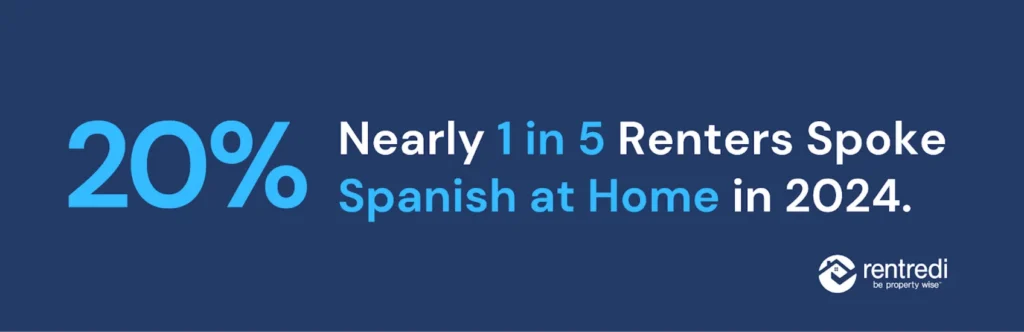
Spanish-speaking renters represent a meaningful and stable segment of the U.S. rental market. Nationally, about 20%, nearly one in five, renters spoke Spanish at home in 2024.
Figure 1*
While the national trend offers helpful context, the real story lies in which metros have the largest Spanish-speaking renter populations and where these renters make up the biggest share of the local rental market.
Below are the top U.S. metros by total Spanish-speaking renters and the top metros by percentage, highlighting how concentrated and influential this demographic is in major housing markets.
Top Metros by Total Spanish-Speaking Renters
These metros have the largest absolute number of renters who speak Spanish at home, reflecting both population size and strong, long-standing Spanish-speaking communities.
Figure 2*
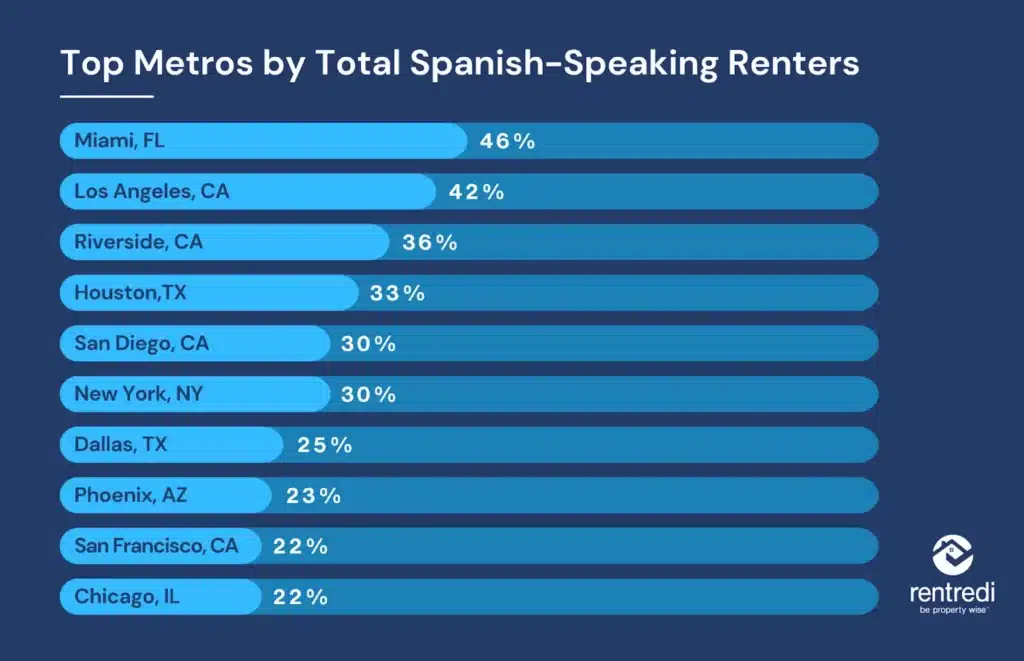
Large metros like Los Angeles, New York, Miami, and Houston dominate in absolute numbers, though their share of Spanish-speaking renters ranges from ~20–46%, reflecting diverse populations.
Top Metros by % of Renters Who Speak Spanish at Home
Some markets have especially high concentrations, where Spanish-speaking households make up more than half of all renters.
Figure 3*
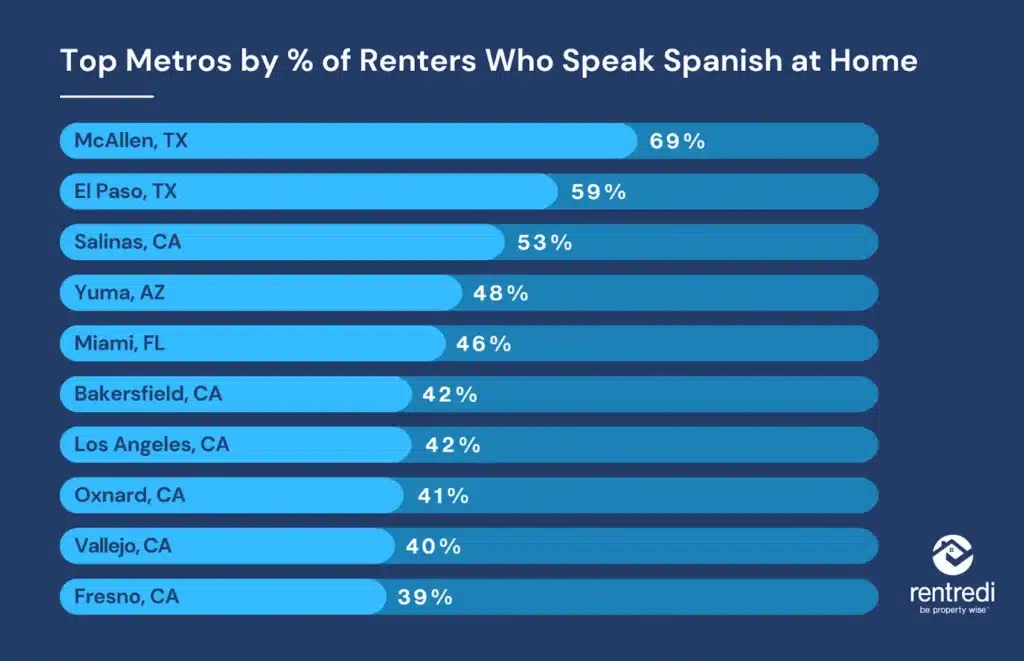
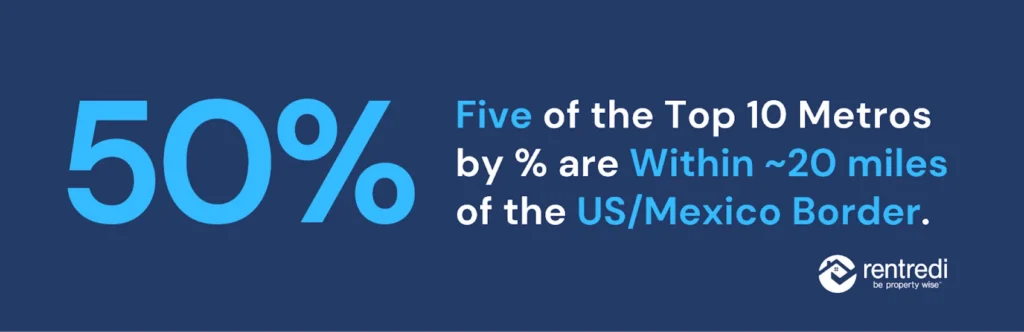
Proximity to the U.S.–Mexico border correlates strongly with high percentages of Spanish-speaking renters: 5 of the top 10 by % are within ~20 miles of the border (McAllen, El Paso, Laredo, El Centro, Yuma). Smaller metros can have majority Spanish-speaking households even with lower total counts.
Figure 4*
Patterns & Takeaways
- Border Influence: Many high-percentage metros are near the U.S.–Mexico border (McAllen, El Paso, Laredo, El Centro, Yuma). Geography clearly drives concentration.
- Southwest Dominance: California, Texas, and Arizona dominate the top metros by percentage.
- Large vs. Small Metros: Large metros have high absolute numbers but lower percentages; smaller metros can reach majority Spanish-speaking populations.
Spanish-speaking renters are a growing and geographically concentrated segment of the U.S. rental market, with the highest densities near the southern border and in major California, Texas and Florida metros.
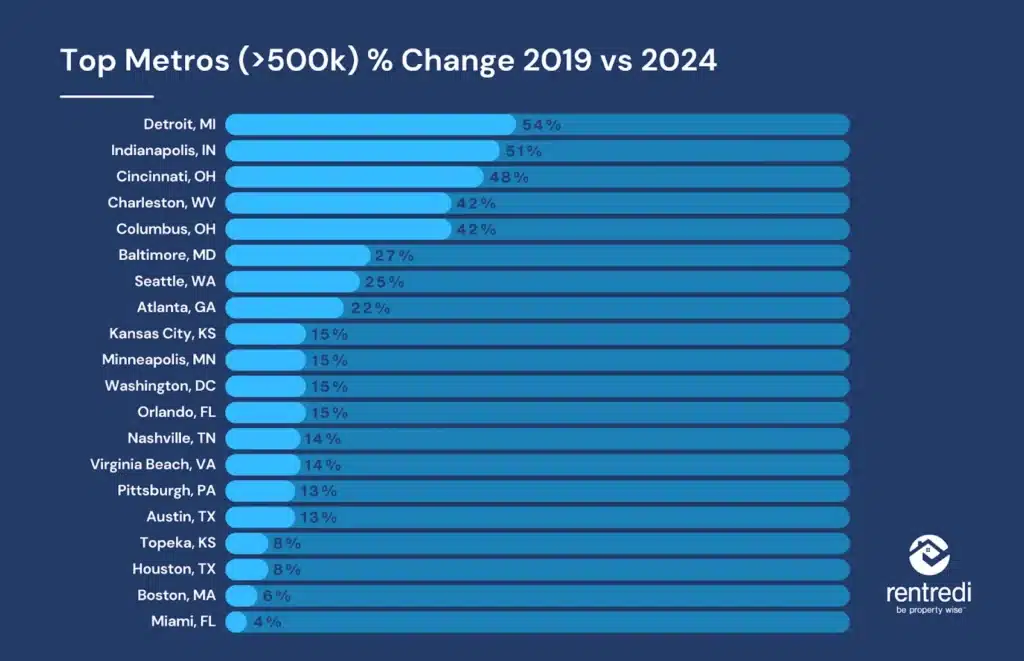
Top Metros (>500k) by % change 2019 vs 2024
Figure 5*
Fastest-Growing Metros
- Detroit-Warren-Dearborn, MI (+54.3%), Indianapolis, IN (+50.8%), and Cincinnati, OH-KY-IN (+48.2%) lead the growth in percentage terms.
- Interestingly, these metros are not traditionally known for large Spanish-speaking populations compared to places like Miami or Houston. This indicates emerging growth in secondary metros, likely driven by migration and economic opportunities.
High-Volume Metros With Moderate Growth
- Miami-Fort Lauderdale-West Palm Beach, FL and Houston-Pasadena-The Woodlands, TX have the largest absolute Spanish-speaking populations (1.15M and 869K in 2024, respectively), but their percentage growth is relatively modest (4.2% and 7.7%).
- This suggests that established Hispanic communities are still growing, but at a slower pace, as they already represent a large base.
Smaller Metros Seeing Significant Percent Changes
- Cities like Pittsburgh (+13.4%) and Topeka (+8.2%) show noticeable growth, even if the absolute numbers are smaller.
Conclusion
Spanish-speaking renters are a growing and influential segment of the U.S. rental market, representing about 20% of all renters nationally in 2024. Large metros like Los Angeles, New York, Miami, and Houston have the highest absolute numbers, while smaller border-adjacent cities such as McAllen, El Paso, and Laredo show the highest concentrations, with Spanish-speaking households making up over half of all renters. Emerging secondary metros like Detroit-Warren-Dearborn, Indianapolis, and Cincinnati are seeing rapid growth, increasing by 50% or more since 2019, signaling shifting demographics beyond traditional Hispanic hubs. Even established high-volume markets like Miami and Houston continue to grow steadily, showing that both long-standing and emerging communities are shaping the rental landscape across the U.S.