Rental Property Recordkeeping Rules Every Landlord Should Follow

Keeping rigorous records is essential for landlords, especially property managers overseeing multiple units. By treating your rentals as a true business and following best practices, you’ll stay organized, maximize financial benefits, and avoid costly mistakes. In this guide, we outline the key recordkeeping rules every landlord should follow. Let’s dive into how solid recordkeeping can […]

13 min read

Keeping rigorous records is essential for landlords, especially property managers overseeing multiple units. By treating your rentals as a true business and following best practices, you’ll stay organized, maximize financial benefits, and avoid costly mistakes. In this guide, we outline the key recordkeeping rules every landlord should follow. Let’s dive into how solid recordkeeping can protect your income, streamline rental property accounting, and simplify tax time.

Quick Takeaways:

  • Treat rentals as a business: Use dedicated accounts and professional habits from day one.
  • Document everything: Track rental property bookkeeping down to each receipt, bill, and lease document.
  • Stay consistent: Update records regularly, reconcile accounts monthly, and use a set accounting method.
  • Leverage technology: Use landlord software to automate tracking and reduce errors.
  • Retain records safely: Store files securely and keep them for the recommended years for taxes and legal protection.

Separate Your Business and Personal Finances

One foundational rule is to never commingle personal and rental finances. Treat your rental income and expenses as a standalone business. This starts with using a dedicated bank account exclusively for rent payments and property expenses. Maintain a separate checking account for your rentals. By doing so, all rent deposits, maintenance payments, and other transactions flow through a single system, making them easy to identify and track.

Using separate accounts is also about legal and tax compliance. Many states require holding tenant security deposits in a separate escrow account, and mixing those funds with personal money can lead to penalties. Beyond that, if you own multiple properties, consider separate sub-accounts or tagging transactions by property. This way, each property’s finances remain distinct. You can produce a mini profit-and-loss report for each unit, and you must prepare a separate Schedule E tax form for each property you own. Segregating accounts demonstrates you run your rental operation like a business, with transparent records and no commingling of funds.

Bookkeeping for landlords illustrated by a real estate agent reviewing documents with homeowners at the front door.

Actionable Tip: Open a new business bank account for your rental activity. Deposit all rental income into it and pay all property-related bills from it. If managing properties for others, use trust accounts as required. This clear division will prevent endless confusion and provide a clean paper trail. As your portfolio grows, such separation becomes even more crucial. It not only helps day-to-day but also provides an audit-ready trail that demonstrates you manage your rental finances professionally.

Track Every Income and Expense in Detail

Accurate bookkeeping for landlords boils down to diligently recording all money flowing in and out of your rentals. Every rent payment, late fee, utility reimbursement, and any other income must be logged. Document every expense related to the property: maintenance, repairs, property taxes, insurance premiums, mortgage interest, management fees, and advertising costs. No transaction is too small to record. By tracking rental property taxes and expenses line by line, you gain a clear picture of your property’s cash flow and profitability. A systematic approach to income and expense tracking is the backbone of successful rental accounting. It not only keeps your finances organized, but also ensures you don’t overlook deductible expenses come tax time. Each dollar you spend on the property affects your bottom line. Meticulously recording these expenditures gives you insight into where your money goes and prevents any “missing” funds. It also means that if a tenant or vendor dispute arises, or if you face an audit, you have the evidence on hand.

How to implement: Establish a process to log transactions regularly. Some landlords use a simple spreadsheet with columns for date, description, amount, and category. Others might use a ledger or an app. Choose a system that you will use consistently. The key is regularity. Set aside time each week or month to update your books. It’s much easier to input receipts and payments as you go than to reconstruct months of transactions from memory. Many experienced landlords treat bookkeeping as a routine part of property management, alongside inspecting a unit or responding to tenant requests. Make it a habit, and your records will always be up to date.

Also, organize by property if you have more than one. This means either maintaining separate spreadsheets or segments in your ledger for each address. That way, you can see the performance of each rental on its own. Did Property A bring in more rent than Property B this year? Is one property dragging down your portfolio with high expenses? Separate records will tell you. Keeping things combined might mask an underperforming unit by averaging with others. By tracking income and expenses on a per-property basis, you ensure each asset stands on its own merits.

Track rent collection diligently. Log not just that rent was paid, but when and how. Note if a tenant paid on the 1st via ACH or on the 5th in cash, for example. Keeping a detailed rent roll with dates can help you spot chronic late payers and enforce policies. It also provides documentation if you ever need to evict for non-payment or prove income for a loan. In short, leave no dollar unaccounted for.

Save Receipts and Documentation for Every Expense

Recording a payment in your ledger is good, but without proof, it may not hold up under scrutiny. Create a habit of saving and organizing all these supporting documents. Good recordkeeping means not only logging a $200 plumbing repair in your spreadsheet, but also keeping the plumber’s invoice and the receipt for the $200 payment. The IRS emphasizes that you generally must have documentary evidence to support your expenses if you want to deduct them. This means that if you claim $5,000 in repair costs on your taxes and are audited, you’ll need to provide receipts or invoices for those repairs. If you can’t, the deduction may be disallowed. But this isn’t just about taxes. Thorough documentation can protect you in other ways, too. Suppose a tenant claims you never fixed a broken appliance. If you have the work order and receipt from the technician who repaired it, you can easily prove the job was completed and paid for. If a vendor attempts to double-charge, your canceled check serves as proof of payment.

Best practices for receipts: Go digital whenever possible. Physical receipts are notorious for fading, getting lost, or piling up in shoeboxes. Consider scanning or photographing paper receipts and storing them in a cloud drive or an app. Many modern rental accounting software platforms allow you to upload receipt images and attach them to transactions. For example, you can snap a picture of a Home Depot receipt for paint supplies and link it to the maintenance expense entry for that property. This not only keeps everything organized but also ensures you have a backup copy. If you prefer physical files, set up a filing system by property and year, and file each paper receipt promptly.

Keep in mind certain documents beyond purchase receipts, too. Save lease agreements, tenant communications, inspection reports, and repair logs. Anything that could serve as a record of an event or transaction related to your rental is worth keeping. Landlords who maintain comprehensive tenant files are better prepared if a dispute ever arises. Organize these documents in a logical way. Many landlords use a combination approach: a digital folder for each property and a corresponding physical file for critical hard copies. Always label files clearly with dates and descriptions. The goal is to enable you to retrieve any required record within minutes when needed. Remember, good documentation is part of good recordkeeping.

Categorize Expenses and Maximize Your Deductions

By grouping expenses into categories, you gain insights into where your money is going. More importantly for landlords, proper categorization ensures you don’t miss out on rental property tax deductions. Landlords are entitled to many deductions, from mortgage interest and repairs to depreciation and beyond. But to claim these, you need detailed records sorted by category. Common categories to use in your bookkeeping include:

  • Maintenance and Repairs: e.g., plumbing fixes, painting, handyman labor.
  • Utilities: if you pay any utilities (water, garbage, electricity for common areas, etc.).
  • Insurance: landlord insurance premiums for the property.
  • Property Taxes: the annual real estate taxes.
  • Mortgage Interest: the interest portion of your loan payments (usually reported by your lender as well).
  • Property Management Fees: if you pay a management company or even certain software fees.
  • Advertising and Tenant Acquisition: listing fees, credit check fees (if you cover them), etc.
  • Administrative: office supplies, mileage for trips to the property or hardware store, legal or accounting fees related to the rental.

By consistently tagging each expense with a category, you make life easier for yourself. You can evaluate your spending patterns and also ensure you don’t forget a deduction. For instance, many landlords forget to track mileage for rental–related trips, but those miles are deductible as a travel expense if properly documented. If you have a category for “Auto/Travel” and you log those miles with dates and purpose, you can deduct them.

Best accounting software for landlords shown as a professional working on a desktop computer in a bright home office.

Let’s briefly discuss capital improvements vs. deductible expenses, as this is a common area of confusion in recordkeeping. Small repairs and maintenance are deductible in the year paid, whereas improvements that add value usually must be capitalized and depreciated over time. It’s important to distinguish these in your records. You might have categories or flags for “CapEx” (capital expenditures), separate from regular repairs. Keep documentation describing the work done. It will help you and your tax preparer determine the proper treatment. If in doubt, consult a tax professional, but your job as a landlord is to have the records either way. Finally, don’t overlook depreciation. While not an out-of-pocket expense, depreciation on the property is one of the biggest tax deductions you get as a rental owner. Keep a record of your depreciation schedules and any asset additions or dispositions.

Be Consistent and Use a Set Accounting Method

Consistency is king in recordkeeping. Landlords should establish a routine for managing their books and stick to it. This includes choosing an accounting method (cash or accrual) and consistently applying it, as well as performing regular reconciliations and audits of your own records. By being methodical and timely, you prevent small errors from snowballing into big problems.

Most individual landlords use cash-basis accounting, meaning you count income when you receive it and expenses when you pay them. This is simpler and often makes sense for smaller operations. Alternatively, accrual accounting counts income when earned and expenses when incurred. Accruals can give a more accurate long-term picture but are more complex. Pick the method that fits your business and understand the implications. Once you pick one, be consistent year over year.

Avoid letting your bookkeeping pile up. Many landlords fall into the trap of procrastinating: tossing receipts in a drawer and telling themselves they’ll “do it later.” Before you know it, it’s the end of the year, and nothing is organized. To prevent this, set a regular interval to update your records, whether it’s every Friday afternoon or the first weekend of each month, and schedule time to bring the books up to date. Log all new income and expenses, file new receipts, and review the past period’s entries for accuracy. This habit keeps you in tune with your property’s performance and makes recordkeeping less overwhelming.

Embrace Technology: Use Software and Apps to Streamline Recordkeeping

Modern problems require modern solutions. In an age where technology touches every aspect of business, landlords have a wealth of tools available to simplify recordkeeping. Utilizing rental accounting software and a rent collection app for landlords can save you time, reduce errors, and provide professional-level financial management at your fingertips.

Why go digital? Managing rentals with pen and paper or basic spreadsheets can become cumbersome, especially as you scale up. Digital tools automate much of the work that landlords traditionally did manually. The best accounting software for rental property owners can automatically log rent payments made by tenants online, generate expense reports, and even prepare key tax documents for you. It’s not about laziness. It’s about efficiency and accuracy. Automating repetitive tasks reduces the risk of human error and improves consistency. Purpose-built landlord software is designed to handle exactly the challenges rental owners face, from tracking income/expenses by property to integrating with online payments and leases.

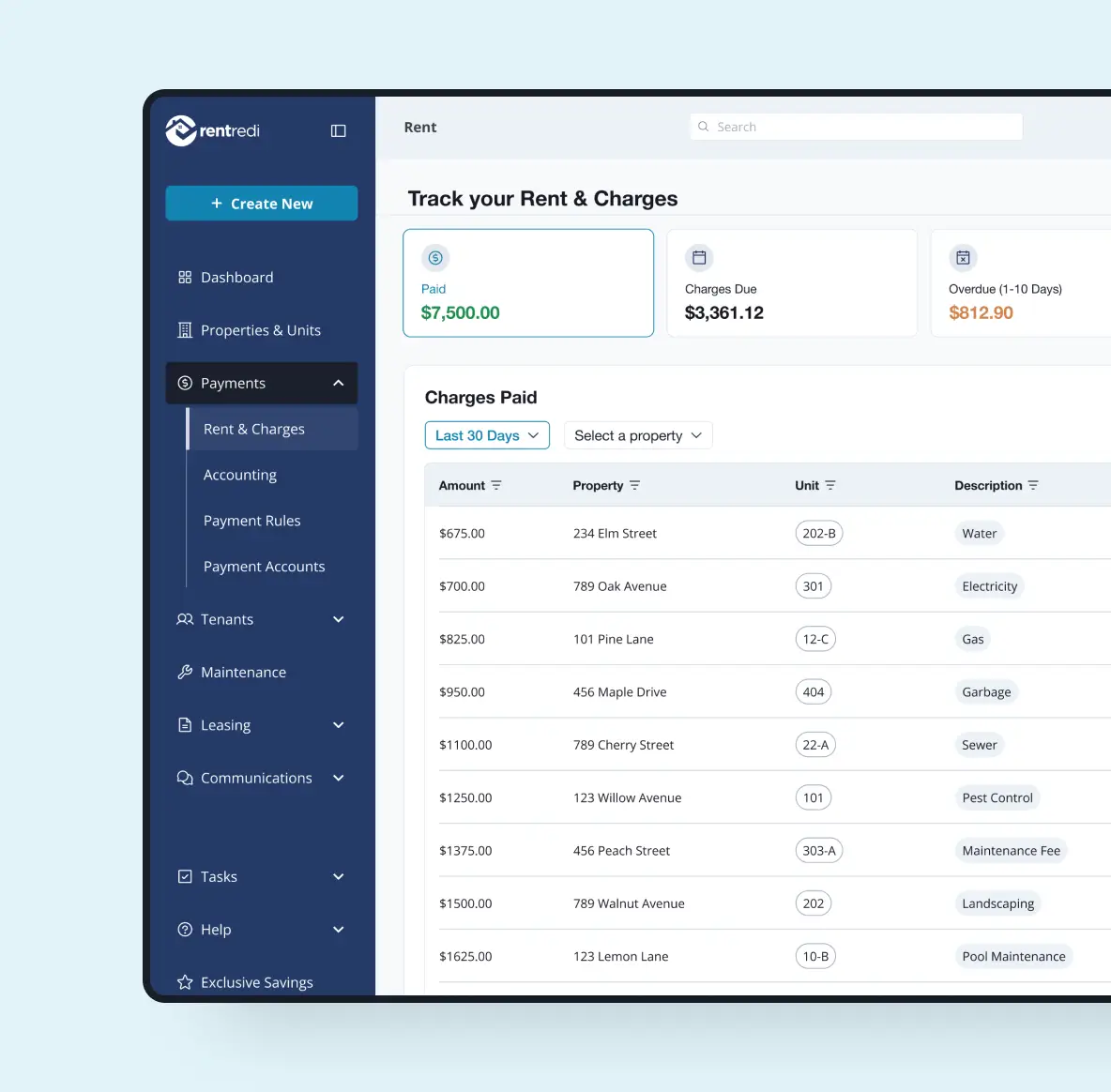
Many landlords initially use general small-business accounting software or simple apps, but they may find that those fall short for rental needs. Dedicated landlord accounting software, such as RentRedi, offers features tailored to rental properties. They often support multi-property tracking. They may include modules for tenant management, maintenance requests, and document storage, so your rental property bookkeeping ties into your tenant records. These systems also often include built-in reminders, such as alerts when a lease is about to expire or when it’s time to raise rents or renew insurance. Crucially, they can automate rent collection and late fees, which directly tie into your financial records.

One big advantage of using digital rent collection is the improvement in on-time payments and record transparency. Studies have shown that while digital payments are now the most common way tenants pay rent, about 40% of renters still pay by paper check or money order. By introducing an easy rent payment app for landlords, you can encourage more electronic payments. This not only reduces the incidence of late or lost checks but also ensures each payment is recorded instantly. When a tenant pays through an app, you get an electronic record with date/time and amount, and often an automatic update to your accounting system. No more waiting on the mail or making bank trips for deposits. Additionally, tenants appreciate the convenience of online payments, especially younger renters who rarely use paper checks. Many apps support ACH (bank transfers), credit/debit cards, and cash payments via partners, giving tenants flexibility while keeping you in the loop. The increase in digital payments is a win-win: tenants pay on time more often, and landlords collect 99%+ of rent due when digital options and incentives like credit reporting are in place.

When selecting the best accounting software for rental properties, consider features like bank integration, receipt scanning, customizable expense categories, and report generation. Also, look at whether it handles things like depreciation tracking or integration with tax prep tools. If you manage properties for others, trust accounting features are important. And of course, ease of use and good customer support are factors. The fanciest software is useless if you don’t actually use it because it’s too complicated. The best accounting software for landlords is one that fits your portfolio size and your workflow, whether that’s a simple mobile app for a couple of units or a robust cloud platform for hundreds of units.

Don’t forget mobile accessibility. It’s extremely useful to snap a photo of a receipt with your phone and attach it immediately, or to check whether a tenant’s payment has cleared while you’re on the go. Most landlord bookkeeping software today offers mobile apps or at least mobile-friendly websites, meaning you can update your records from anywhere.

Rent collection apps often include additional benefits, such as automatic reminders for tenants, the ability to enable auto-pay, and features like splitting payments between roommates or scheduling partial payments. These features remove you from being the “nag” for rent. The system handles it. When rent comes in, it’s logged, and you can have the app deposit it directly into the dedicated bank account we set up in Rule 1. Just be aware that as you grow, investing in proper property management and accounting software can greatly simplify your life.

Financial records aren’t the only documents you need to keep. Comprehensive recordkeeping for landlords also means maintaining organized files on tenants, leases, and the property itself. These records can be your first line of defense in legal disputes and are critical for effective property management. Every landlord should have a system for storing leases, tenant communications, maintenance logs, and other important documents, and should know how long to retain them.

Retain and Back Up Records for the Required Time Periods

The final rule addresses how long to retain these records and how to ensure they’re securely backed up. Record retention is a vital part of recordkeeping discipline. It’s no use to meticulously maintain documents if you discard them too soon or lose them in a computer crash. Every landlord should follow guidelines for how long to retain different types of records and implement a backup system for important files.

Property management and accounting software displayed on dual monitors in a modern office workspace.

For tax-related documents, the IRS generally recommends retaining supporting documents for at least three years after the return’s filing date. This is because the IRS typically can audit returns filed in the last three years. However, there are scenarios where they can go back farther – up to six years if they suspect significant underreporting of income, or indefinitely in cases of fraud. Many financial advisors thus suggest keeping records for seven years, which covers the 6-year audit window plus a cushion. Keeping seven years of records is a common and prudent approach for landlords. If you sold a property, keep its records for at least that long after the sale, as they may be relevant to tax audits or capital gains calculations.

For property documents and leases: Keep leases and related tenant files at least a few years after the tenant moves out. A common recommendation is at least 5 years, because a tenant might sue over a security deposit or an injury within the statute of limitations. If your state’s laws say tenants have X years to bring certain claims, use that as a baseline. Documents related to property ownership should be kept as long as you own the property. Mortgage documents and payoff statements should be kept indefinitely or at least until the loan is settled and you have proof of payoff. Insurance policies are kept for the policy period plus a few years. If there’s a claim, keep those records indefinitely related to that incident. These timelines are considered rental property recordkeeping best practices, as they balance practicality with protection.

By following these rental property recordkeeping rules, you’ll establish a rock-solid foundation for your landlording business. You’ll find that decisions become easier with clear data at hand, tax season becomes far less stressful, and potential disputes are much easier to resolve in your favor. From the start of a tenancy to years after it ends, your diligent records are your secret weapon. In summary: keep finances separate, document everything, stay organized with consistency and tech tools, and retain records for the long haul. These habits may require some effort to establish, but they deliver financial savings, peace of mind, and professionalism.

Sources:

  • Internal Revenue Service – Rental Income and Recordkeeping Guidelines
  • Justia Legal Resources – Recordkeeping Practices for Landlords
  • Multifamily Dive – Nearly Half of Renters Still Pay by Check (Rent Payment Trends)