Most landlords treat on-time rent as a matter of luck. You either get a good tenant or you don’t. RentRedi’s own platform data tells a different story: on-time payment isn’t luck, it’s built in stages, and it starts well before a tenant ever signs a lease.
We pulled the numbers from four points in the rental lifecycle (applications, screening, rent collection, and credit reporting) to see exactly how much each one moves the needle. The pattern was consistent: every system a landlord puts in place compounds on the last one.
Quick Answer
Across RentRedi’s platform data, tenants who go through an application and prequalification process pay their first month’s rent about a month sooner.
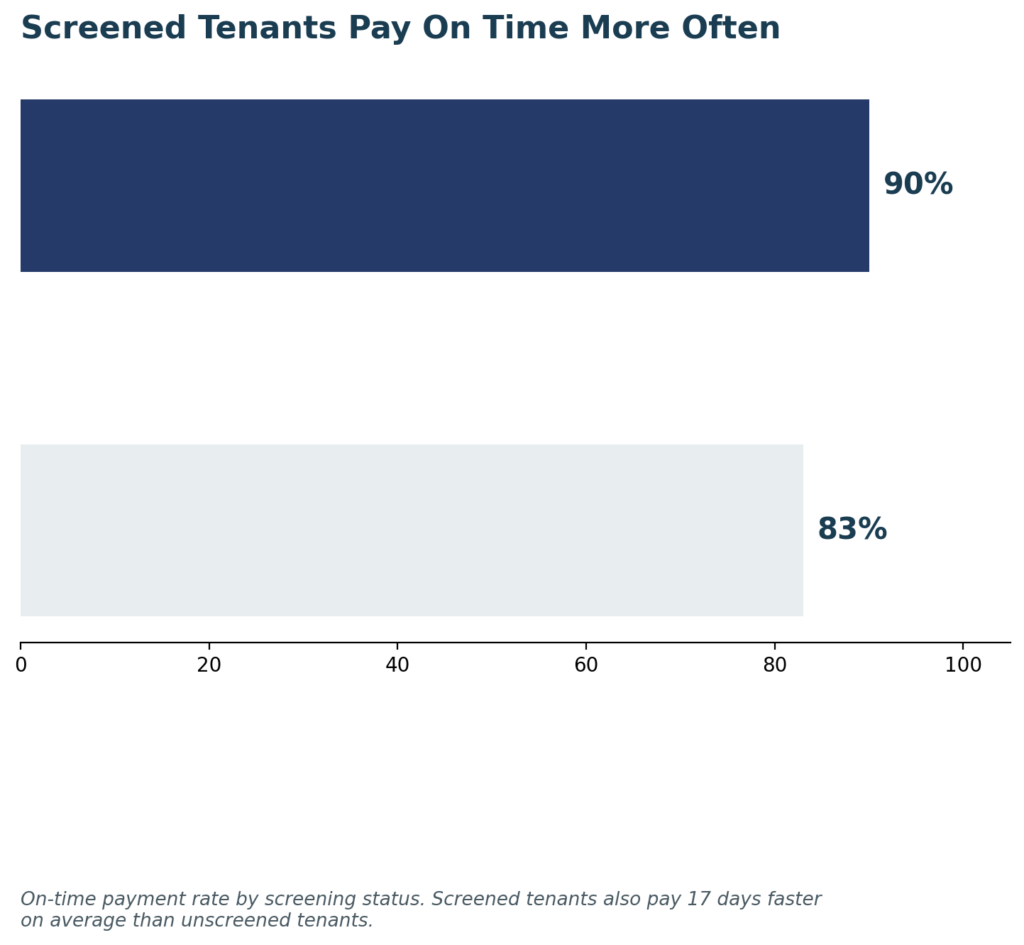
- Screened tenants on RentRedi pay on time 90% of the time (vs. 83% without screening) and pay 17 days faster.
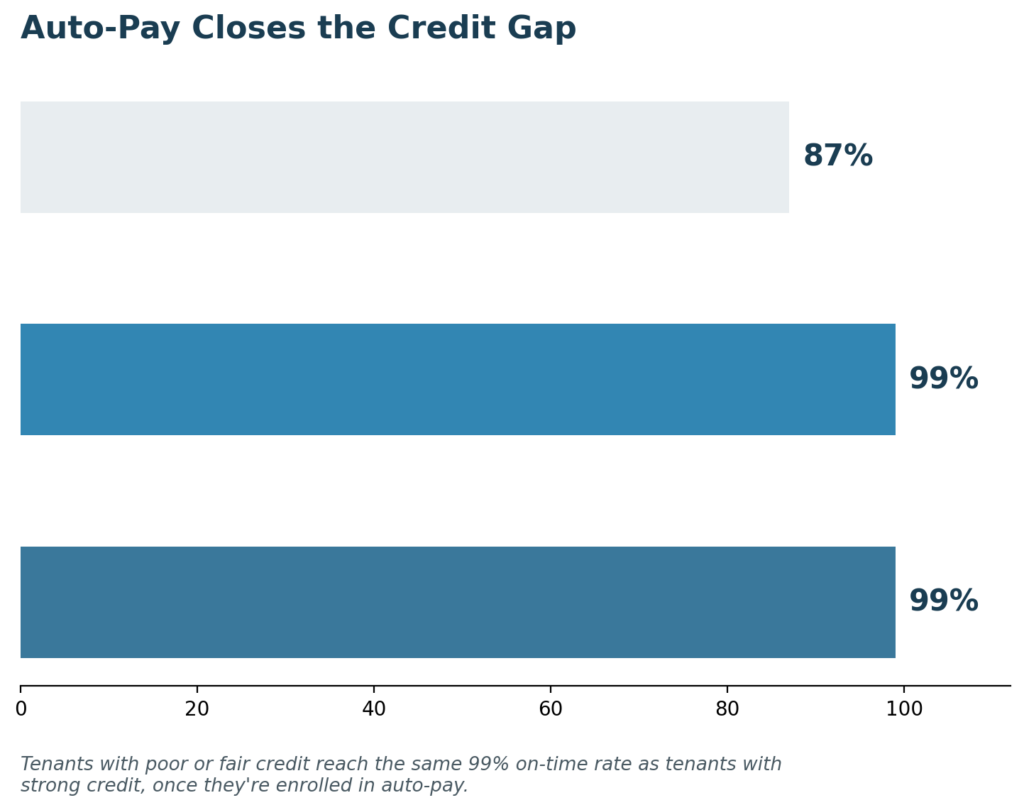
- Tenants on auto-pay hit 99% on-time payments, even those with poor or fair credit.
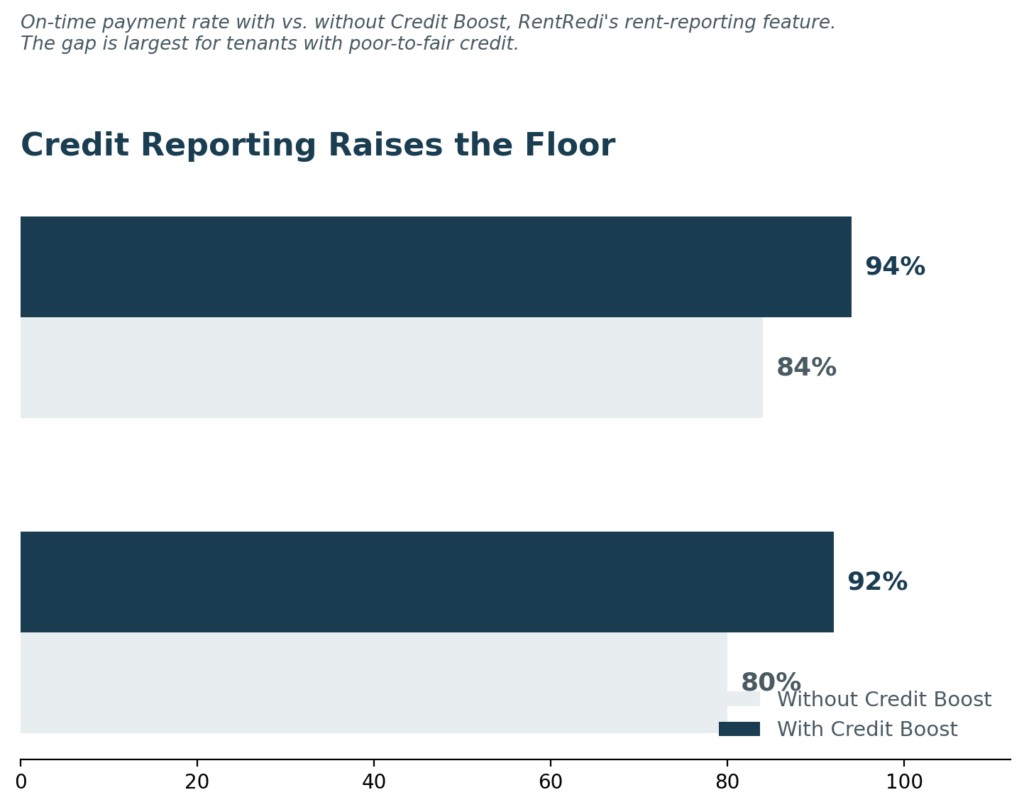
- And tenants using RentRedi’s rent-reporting feature average 94% on-time payments vs. 84% without it.
- Each stage adds reliability on top of the last.
Who This Data Is For, and Where It Comes From
This breakdown is built for independent and small-portfolio landlords deciding which parts of their rent collection process are worth tightening up first: application requirements, screening, payment method, or credit reporting incentives.
For broader market context: Chandan Economics‘ Independent Landlord Rental Performance Report, which draws on RentRedi platform data across tens of thousands of units, puts on-time payments for independently operated 2–4 family rentals at 84.6% in June 2026, with single-family rentals close behind at 84.0%.
That’s the baseline this article’s numbers should be read against, most of the stats below describe outcomes for tenants who’ve gone through one or more of RentRedi’s systems, not the industry as a whole.
It Starts Before Move-In: Applications & Prequalification
The first data point in the rental lifecycle happens before a tenant ever pays rent: the application itself.
Units where a tenant went through a RentRedi application and prequalification see that tenant pay their first month’s rent roughly one month sooner than units where no formal application process took place.
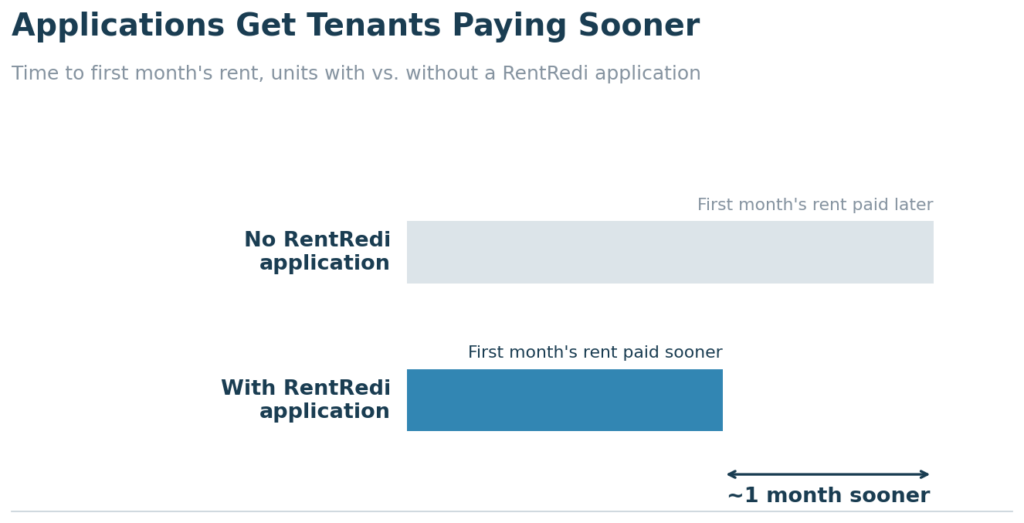
That gap makes sense once you consider what an application actually filters for. Prequalification surfaces income, rental history, and red flags before a lease is signed, the same qualities that predict a tenant who pays promptly once they move in.
Landlords who skip this step to fill a vacancy faster are often trading a few days of vacancy for a slower start on rent once the unit is filled.
The Screening Effect: Faster and More Reliable Payments
Tenant screening builds directly on the application step, adding background, credit, and eviction history to the picture.
On-Time Rates by Screening Status
- On-time payments reach 90% for tenants who went through RentRedi tenant screening, compared with 83% for tenants who weren’t screened.
- Screened tenants pay 17 days faster than unscreened tenants.
Why 17 Days Matters for Cash Flow
Seventeen days is more than half a rent cycle. For a landlord managing cash flow across several units, that’s the difference between rent arriving before the mortgage is due and scrambling to cover it out of pocket. Screening isn’t just risk management: it’s a cash-flow tool.
Auto-Pay: The Great Equalizer for Rent Collection
This is where the data gets most interesting.
On-Time Rates by Payment Method
Across all tenants, the overall on-time payment rate is 87%. Tenants enrolled in auto-pay reach 99%, a jump that holds regardless of credit profile.
Closing the Credit Gap
Tenants with poor or fair credit who use auto-pay also reach 99% on-time payments, statistically indistinguishable from tenants with strong credit. (For reference, Experian defines poor credit as scores below 580 and fair credit as 580–669 on the FICO scale, so this isn’t a marginal group; it’s tenants who’d typically be flagged as higher-risk on a standard credit check.)
In other words, credit history predicts on-time payment behavior only when payment is manual. Once rent collection is automated, the payment method does the work that credit history used to signal. For landlords, that reframes auto-pay from a “nice-to-have convenience feature” into one of the more reliable de-risking tools available, arguably more predictive than the credit check itself.
Credit Reporting: Turning Rent Into a Two-Way Incentive
The fourth stage is Credit Reporting, RentRedi’s feature that reports on-time rent payments to all three major credit bureaus: TransUnion, Equifax, and Experian. While auto-pay removes friction from paying, credit reporting adds a reason to pay on time: a tenant’s credit score can benefit from it.
Overall Impact
Tenants using Credit Boost average 94% on-time payments, vs. 84% for tenants who don’t use it.
The Poor-to-Fair Credit Segment
Among tenants with poor-to-fair credit specifically (again, sub-670 on the Experian/FICO scale), the gap holds: 92% on-time with Credit Boost vs. 80% without.
The poor-to-fair credit segment is the one worth paying attention to. These are tenants who, on paper, look like the highest risk, and credit reporting closes most of that gap. It turns rent payment into something the tenant is personally invested in, not just an obligation to the landlord.
Putting It Together: Why These Systems Compound
None of these four data points work in isolation. They represent four separate points in the same relationship, each reinforcing the last:
- Applications & prequalification filter for tenants likely to pay reliably from day one.
- Screening adds verified history on top of that, tightening the pool further and speeding up first payment.
- Auto-pay removes the friction that turns “intends to pay on time” into “actually pays on time,” regardless of credit background.
- Credit reporting gives tenants an ongoing, personal incentive to keep that streak going, month after month.
A landlord who uses only one of these tools gets a partial benefit. A landlord who uses all four is looking at a fundamentally different on-time payment rate than the portfolio average.
An Illustrative Example
The following is an illustrative scenario, not a specific tenant record.
Consider two identical one-bedroom units in the same building, both renting for $1,500/month. One landlord accepts an applicant without screening, collects a paper check, and doesn’t offer credit reporting. The other requires an application and screening, sets the tenant up on auto-pay, and enrolls them in Credit Boost.
Based on the data above, the second landlord isn’t just reducing risk on paper. They’re plausibly the difference between a tenant who pays on time 8 or 9 months a year and one who pays on time essentially every month. Over a 12-month lease, that’s the difference between one or two stressful, late-rent conversations and none.
Common Mistakes Landlords Make With This Data
- Treating screening as a one-time gate, not a system. Screening only pays off if it’s applied consistently to every applicant, not just the ones who seem risky at a glance.
- Offering auto-pay but not promoting it. Auto-pay only closes the credit gap for tenants who actually enroll. If it’s buried in a settings menu, adoption and the benefit both stay low.
- Assuming credit reporting is only a tenant perk. Landlords sometimes treat credit reporting as a nice-to-have for renters rather than recognizing it directly improves their own on-time collection rate.
- Skipping prequalification to fill a vacancy faster. The days saved on vacancy are often smaller than the delay in first payment that follows from skipping this step.
FAQ
Does tenant screening actually improve on-time rent payments?
Yes. RentRedi platform data shows screened tenants pay on time 90% of the time, compared to 83% for unscreened tenants, and pay 17 days faster on average.
Does auto-pay help tenants with bad credit pay rent on time?
Yes, this is one of the more notable findings. Tenants with poor or fair credit who use auto-pay reach 99% on-time payments, matching the rate for tenants with stronger credit.
What is Credit Boost and does it really change payment behavior?
Credit Boost is RentRedi’s feature that reports on-time rent payments to TransUnion, Equifax, and Experian. Tenants using it average 94% on-time payments vs. 84% for those who don’t, because timely payment now affects their credit score.
How much sooner do screened or prequalified tenants pay their first month’s rent?
Tenants who go through an application and prequalification process pay roughly one month sooner than tenants who don’t. Screened tenants pay 17 days faster, specifically at the ongoing payment stage.
Do I need all four of these features to see a benefit?
No, each stage shows a benefit on its own. But the data suggests the effects compound, so landlords using applications, screening, auto-pay, and credit reporting together see the most reliable on-time payment rates.
The Bottom Line
On-time rent isn’t determined at move-in and then left to chance. It’s shaped at every stage of the relationship: who you let apply, how thoroughly you screen them, how easy you make it to pay, and whether paying on time benefits the tenant directly. The data shows each stage adds measurable reliability, and landlords who build all four into their process see the strongest results.
Ready to put this data to work?
See how applications, screening, auto-pay, and credit reporting work together on your own portfolio.