TABLE OF CONTENTS
Track key rental business KPIs with RentRedi to boost cash flow, retention, and growth. Learn the metrics smart landlords use to scale successfully.
Running a rental business isn’t just about collecting rent; It’s about knowing what the numbers are really telling you. Behind every filled unit or maintenance call, there’s data that shows how healthy your business truly is.
Smart landlords don’t leave growth to chance. They track key performance indicators (KPIs) to see what’s working and what’s not. With a tool like RentRedi, you can see those numbers in real time and make better decisions.
Don’t worry; This page shares with you the KPIs to use for your rental business. Read on to learn how to track and measure these key metrics for informed decisions in real estate.
KPIs Every Rental Business Should Track
There are key metrics every landlord should track. These do not only apply to marketing but also for their rental business in general. The right KPIs give you a clearer view of your real estate operations. That way, you’re not just reacting to problems but staying two steps ahead.
As you can see, managing finances efficiently matters more than ever. Landlords who track key KPIs know how much time bookkeeping and accounting can take. That’s why using outsourced bookkeeping for SMBs helps. It keeps your records accurate and reporting on time, freeing you to focus on growth instead of spreadsheets.
However, there is more to financial management than meets the eye. Google search lists most of the KPIs used in real estate (see below); However, we’ll tackle some of the most important key metrics for your rental business. That said, here’s what to track and measure:
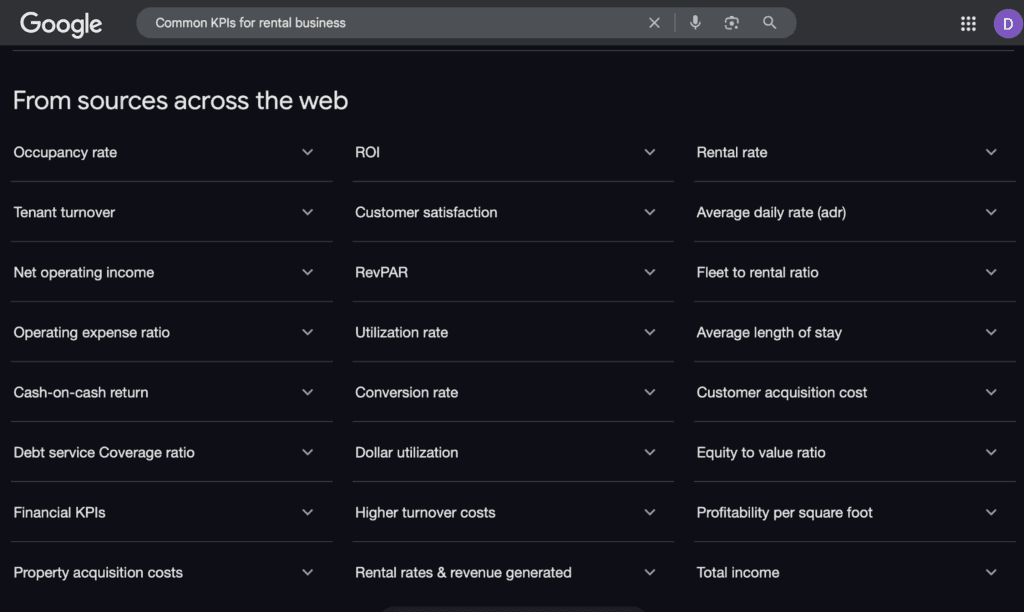
Image source: Google search
Occupancy/vacancy rate: This shows how often your units are filled vs. sitting empty. A high occupancy rate means consistent income. Meanwhile, long vacancies signal pricing and/or marketing issues.
Tenant retention/turnover rate: The fewer tenants you lose, the more stable your revenue. Tracking turnover helps you spot what’s driving people away and make improvements that keep tenants longer.
Maintenance and repair costs: Every repair affects your bottom line. Monitoring these costs helps you budget better. This lets you prevent small issues from becoming big ones and plan for long-term improvements.
Rent collection income: A reliable rent payment process keeps your cash flow steady. Automating rent collection through platforms like RentRedi reduces missed payments. They help you save time while keeping tenants accountable.
Delinquency rate: This metric tells you how many tenants are behind on rent. A rising delinquency rate can point to financial strain among tenants or gaps in your rent collection process. Needing quick attention!
Net operating income (NOI): Your NOI shows your real profitability after operating expenses. When you track it regularly, you can see how decisions impact your true bottom line.
Rental business cash flow: The heartbeat of your rental business, it’s the money left after all bills are paid. It shows whether your operation is financially healthy or stretched too thin.
Why key metrics matter in property management
Running a rental business without tracking performance is like driving with a foggy windshield. You might move forward, but you can’t see where you’re going. Key metrics help landlords bring clarity to their operations. KPIs show what’s working, what’s wasting money, where to focus next, and more.
Financial pressures like high-interest debt or unexpected property expenses can make tracking rental KPIs, such as rent collection, maintenance costs, and net operating income, more challenging. Debt relief addresses these financial burdens, creating clarity in cash flow and expense monitoring.
That said, here’s why KPIs are essential in property management:
Image source: Generated via ChatGPT
Measure financial performance. Tracking rental KPIs lets you see your real financial health. It’s not just the rent you collect, but how much profit remains after expenses. It’s the first step to knowing whether your business is sustainable or needs a strategic pivot.
Spot inefficiencies and hidden costs. Metrics reveal the leaks you can’t see at first glance. Think regular upkeep, frequent repairs, delayed turnovers, and overpaid vendors. Catching these early helps preserve profits and streamline daily operations.
Ensure high tenant retention and demand. Happy tenants stay longer and fill vacancies faster. Monitoring occupancy and turnover rates helps you keep your properties desirable and competitive in the market.
Make data-driven property management. Numbers tell the real story. Decisions grounded in data (not just gut feel) lead to better outcomes and fewer costly surprises.
Support scalable business growth. Once you’ve mastered your metrics, expansion becomes smoother. With these in place, you can confidently increase returns and build a sustainable portfolio.
How To Track and Measure KPIs for Your Rental Business
As a rental business, you list your properties, schedule social media posts, communicate with tenants, approve maintenance requests, and collect rent payments. But beyond managing daily tasks, tracking KPIs helps you see how well everything is actually working.
Whether short-, mid-, or long-term rental, setting up a reliable KPI-tracking system helps you stay proactive rather than reactive. When you know how your rentals are performing in real time, you can make informed choices that boost profitability and efficiency.
That said, here’s how to monitor your rental business performance and measure your key metrics:
1. Set your goals and pick relevant key metrics
Of course, goal-setting is the initial step you’ll take. What do you aim to achieve in measuring KPIs for your rental business? Is it to increase your occupancy rate or decrease your vacancy rate? Is it to boost your tenant engagement and retention? Or is it to maximize your ROI and maintain your cash flow?
Andrew Bates, COO at Bates Electric, claims that goal-setting and KPI measurement go hand in hand. He believes that setting clear objectives helps you pick and track the right key metrics.
Bates says, “You can’t improve what you don’t define. Clear goals give your KPIs purpose by telling you what success actually looks like. Without that direction, you’re just collecting data instead of driving results.”
2. Gather accurate data from reliable sources
The next step to take is to collect pieces of information, however, from trusted sources. Fret not…customer relationship management (CRM) systems let you record and organize data, all in one place. Likewise, you can use AI-powered analytics tools to analyze these datasets and generate accurate reports for informed decision-making for your rental business.
Jeffrey Zhou, CEO and Founder of Fig Loans, highlights the value of data-driven insights for any business, whether in finance or real estate. He suggests leveraging digital tools and advanced technologies to monitor your performance, collect key data, and measure them against your set KPIs.
Zhou explains, “Data is the backbone of smart decision-making. When you track the right numbers through reliable tools, you turn guesswork into strategy. The more accurate your data, the more confidently you can steer your business forward.”
3. Use property management software to organize and measure metrics
It’s quite apparent: Technology shapes the future of property management in real estate. As cited, you can use CRM systems and analytics tools to organize collected datasets and measure them against your key metrics. However, it’s best to leverage a unified software platform to handle various property management functions in one place!
Let’s take RentRedi’s smart property management, for instance. They offer a centralized platform for managing various functions, from screening potential renters to communicating with tenants to collecting rental payments. Likewise, they allow you to track your rental business performance and measure your data against your set KPIs.
4. Review performance regularly and compare against set benchmarks
Sure, you have to monitor your rental business performance regularly. However, it’s also imperative to examine your performance against your key metrics. Are you able to increase your occupancy rate and decrease your vacancy rate? Do you effectively engage your tenants and build good relationships? More importantly, does your rental business earn more from rent collections than it spends on maintenance costs?
Adrian Iorga, Founder and President of Stairhopper Movers, recommends conducting performance reviews regularly. He believes this allows you to see whether your business is doing well and whether you need to make some key improvements.
Iorga shares, “Regular performance reviews keep your business honest. They show you what’s working, what’s lagging, and where to adjust before small issues turn into big problems. Consistent benchmarking is how you stay competitive and continuously improve.”
5. Adjust strategies based on insights and trends
Finally, you’ve reached the most crucial step: Improving your rental business performance. Of course, that’s the main reason you’re setting KPIs and measuring your performance. That is to identify your areas for improvement and adjust your rental strategies based on data-driven insights and real estate trends.
Data without action is just noise. The real value comes from using those insights to refine your strategy and stay ahead of market shifts. When you adapt based on trends, you’re not just keeping up, but you’re setting the pace.
Final Words
Growing a rental business takes more than intuition; It takes insight. The landlords who consistently track their KPIs are the ones who spot trends early, cut waste, keep tenants, and ultimately make their portfolios thrive.
If you’re ready to make smarter moves with less stress, see how RentRedi can help. Book a live demo to discover how one platform can simplify your property management, all while helping you grow with confidence.
Top Rental Business KPIs Smart Landlords Track to Grow Faster with RentRedi